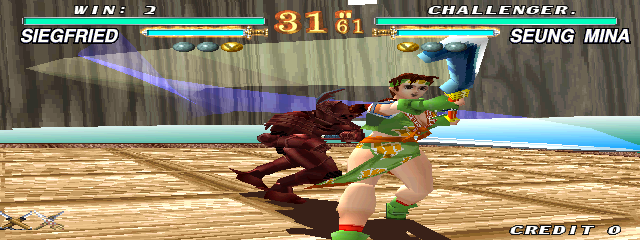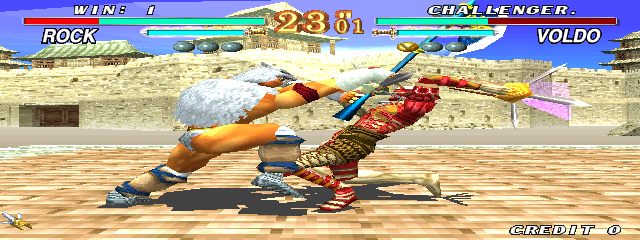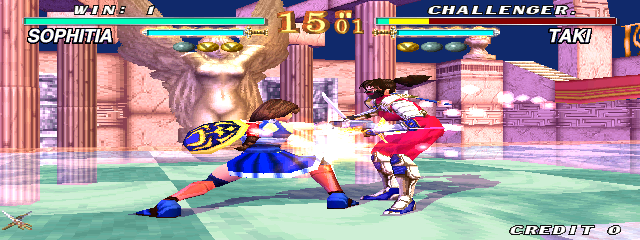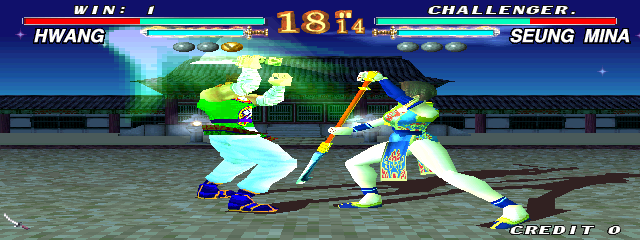
EDITOR'S NOTE:
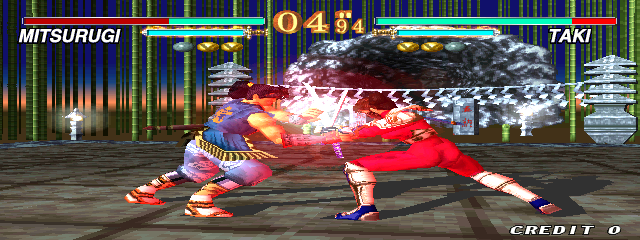
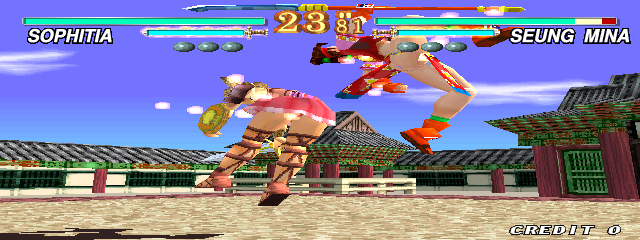
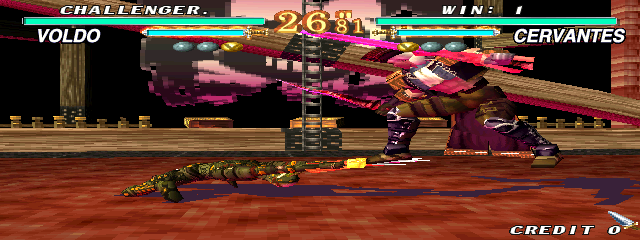
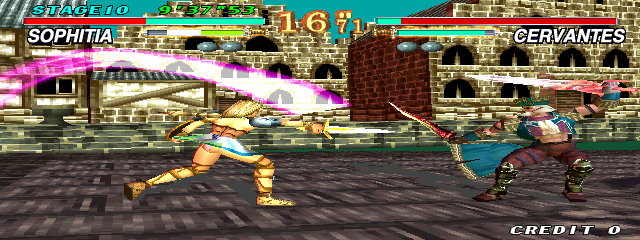
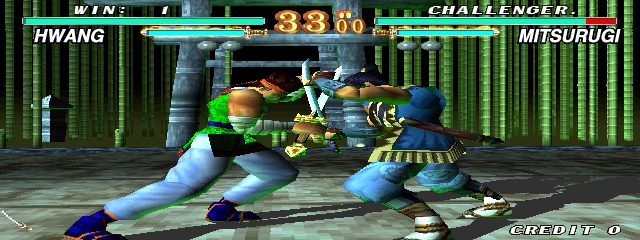
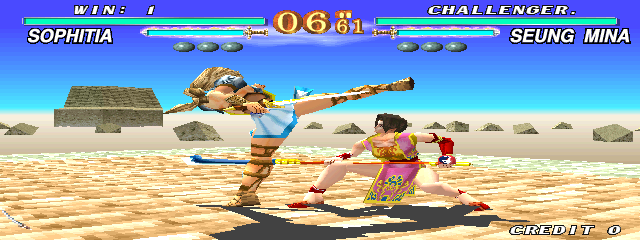
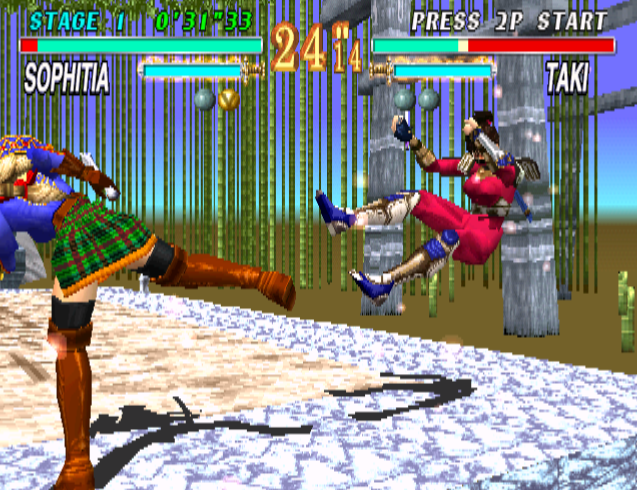
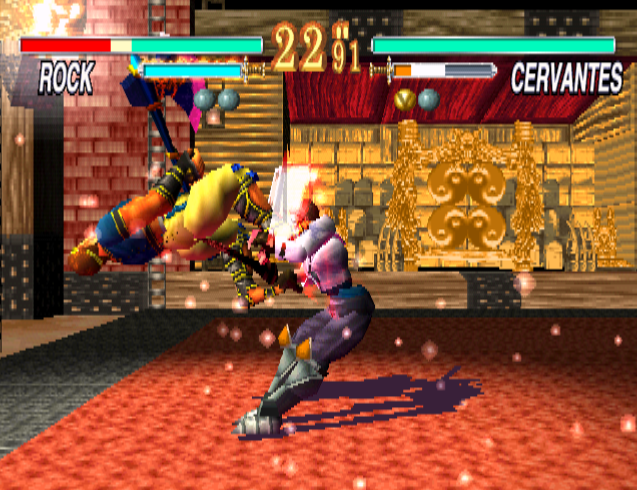
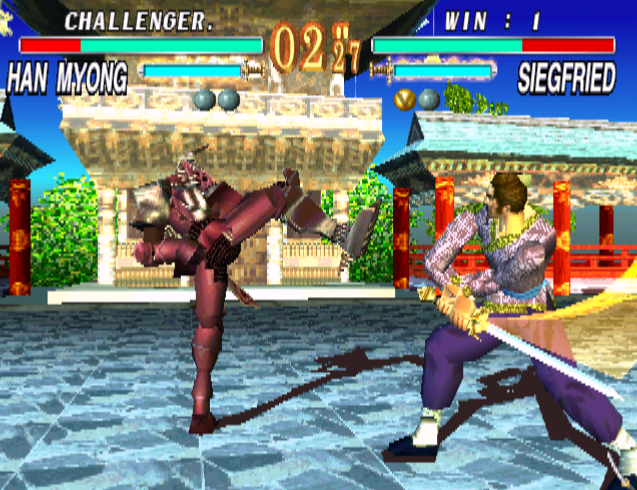
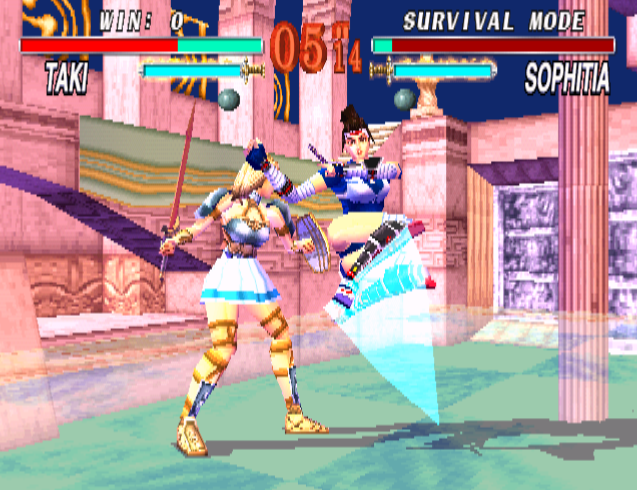
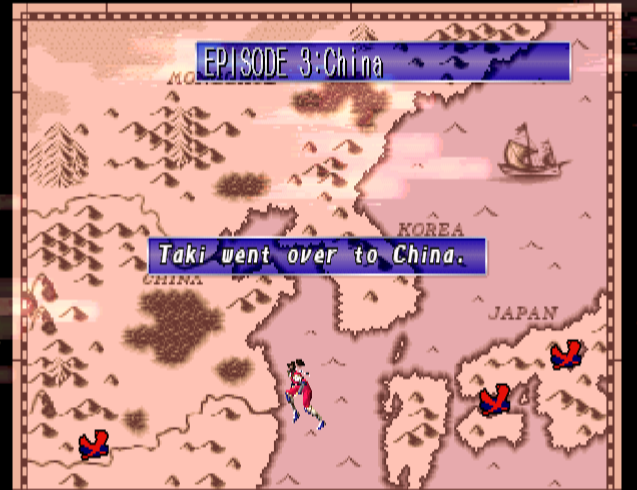
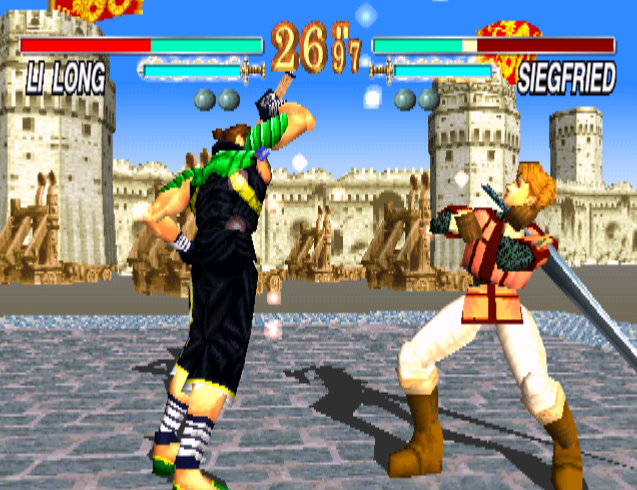
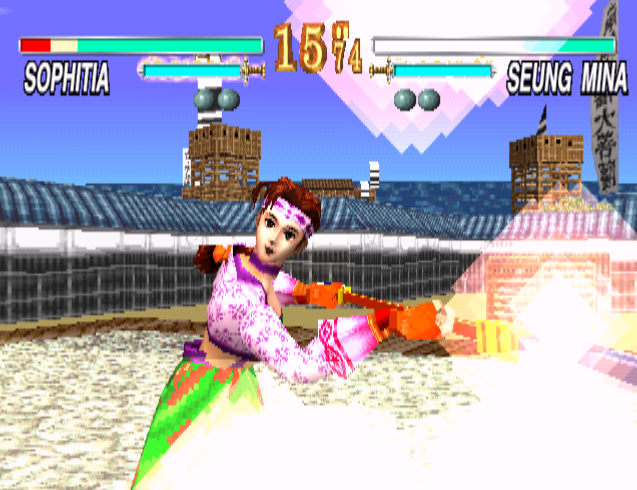
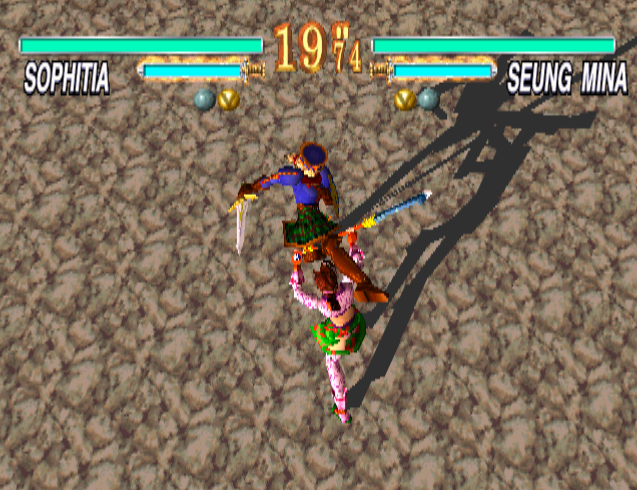
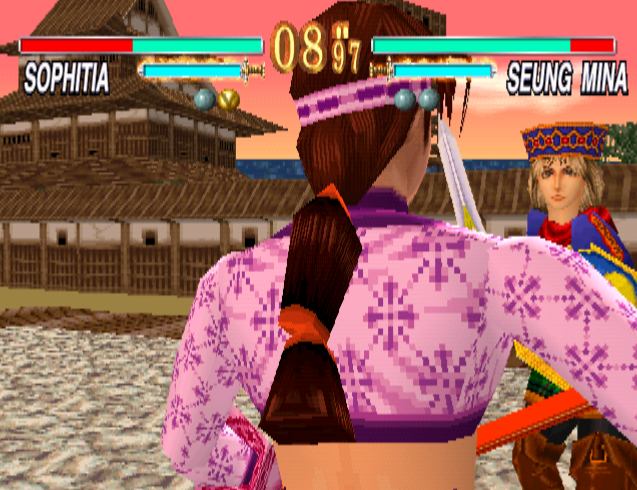
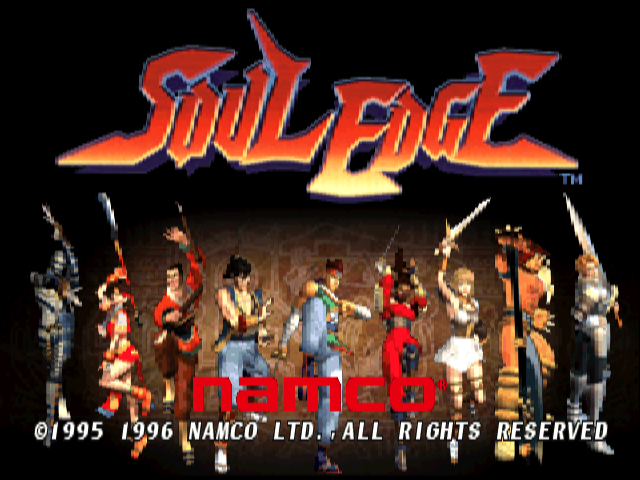
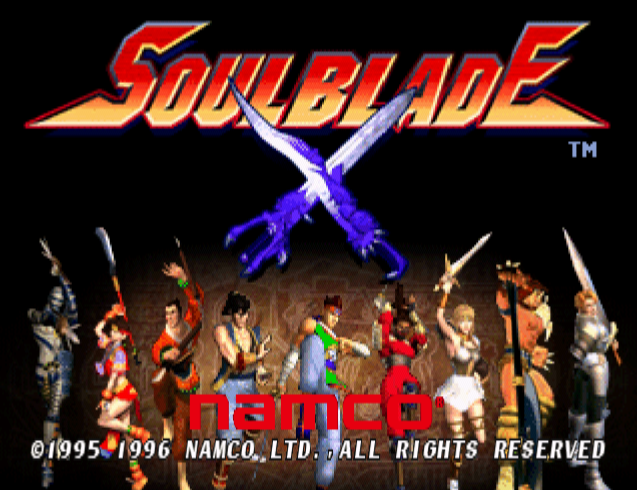
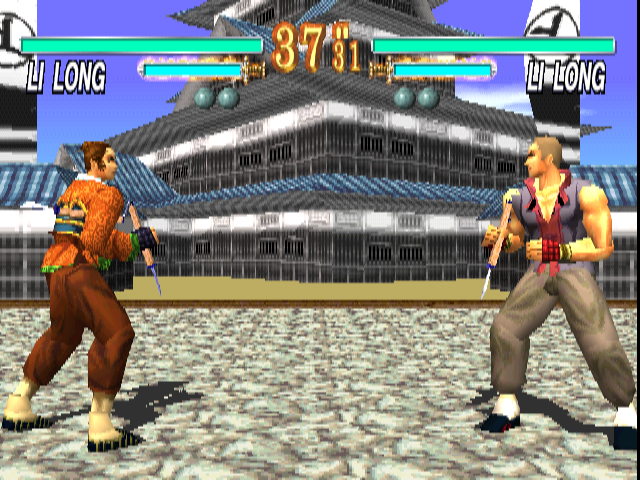
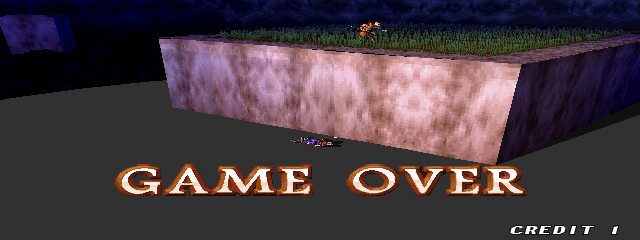
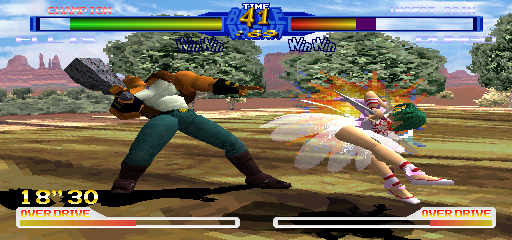
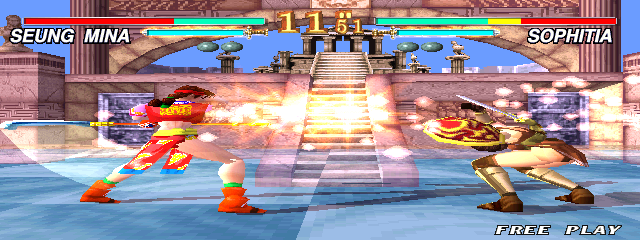
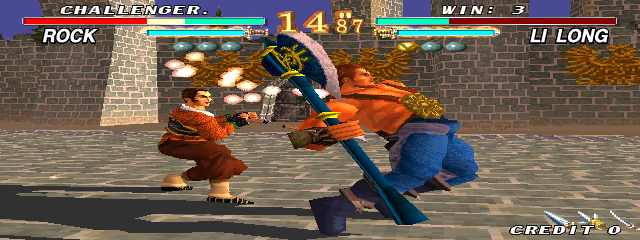
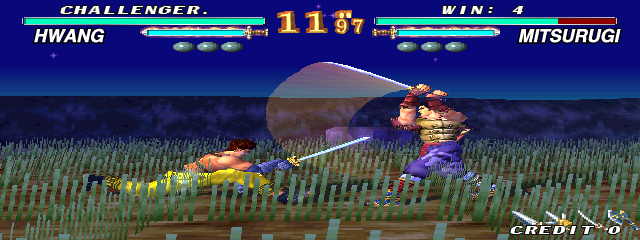
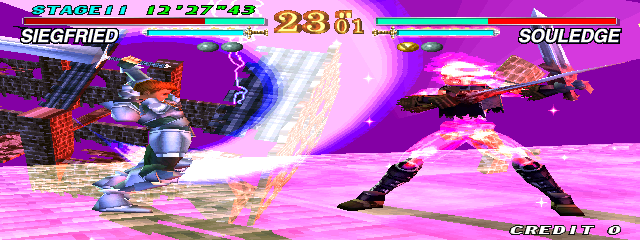
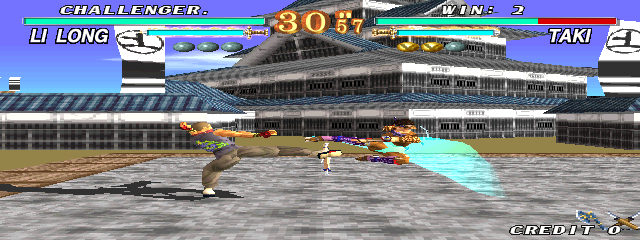
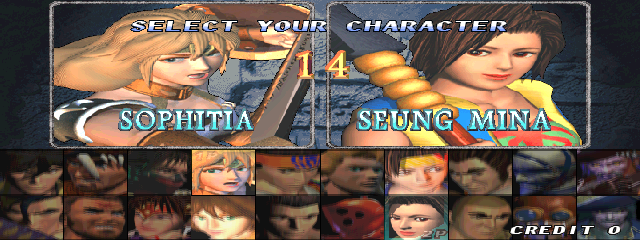
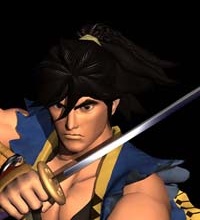
Special thanks to Ultra Powerful Pal of Gaming Hell HokutoNoShock for helping out by playing a few sessions of the Playstation version of this one in versus mode (complete with bonus matches using the ridiculous extra weapons found in Edge Master Mode). Technical issues and our insistence at trying to have screenshots taken at their native internal resolution mean we couldn't use shots from those settings, alas. So we have screenshots taken in our own time, both from the arcade and Playstation ports with the arcade game shots being stretched and adjusted via HTML (unless you really want to see the game in ultra-widescreen / Hidamari Sketch mode, that's the internal resolution after all). The emulation should be pretty on-point for these titles now (better than it has been, check out this psychadelic Li Long shot from an old version of MAME!) but excuse any visual glitches you might see. Finally, this review is based primarily on the Ver. II arcade version, and we'll explain more about that below.

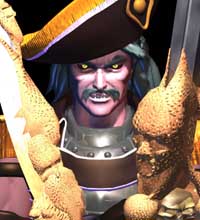
Transcending history and the world, a tale of souls and swords, eternally retold...

Let's go back to the first time this tale was told then, shall we?


I think the best way to start this is to talk about my own personal history with Namco's Soul series of fighting games, 'cause it's a little unusual and sets the scene for what we're about to look at. See, my introduction to it was actually near the beginning- after me and my brother played the absolute shit out of the Playstation ports of Tekken and Tekken 2, Namco's fighting games made an impression on us, which is probably why when they ported their latest fighter to the Playstation, known to us then as Soul Blade, we were immediately on it and played it to death, unlocking every weapon, every secret, all of it. You'd think this would make me a Soul series fan for life, and yet because both the Dreamcast and Playstation 2 sort-of passed me by when they were new, the entire SoulCalibur series basically passed me by until, and I promise this is true, I played my first one properly, that's right, the universally-beloved SoulCalibur V because it was cheap on Xbox 360. I then worked my way backwards through the series (more or less) and it turns out, those SoulCalibur games? Pretty good! However, I don't think it's too over-the-top to say that the original Soul Edge has been somewhat forgotten in the shuffle- sure, it's well-known to those who were there at the time, but I've definitely seen people consider SoulCalibur the 'true' start of the series, and I get that, but it does seem a little unfair. It can't even quite get the accolade of being the first 3D weapons-based fighting game on the market either- Battle Arena Toshinden on the Playstation beat Soul Edge to the market by just over a year and its sequel made its arcade debut at the very end of 1995, and if you really want to go back you can include 1994's Sento on MS-DOS in this discussion (although it is listed on the Motion Capture website as the first video game to use passive optical markers in motion capture, so it's got that). So, why don't we do what Gaming Hell does best and take a look at a game somewhat in the shadow of the games that came later? You know, a little bit like The Fairyland Story compared with Bubble Bobble. We love doing that here!


Alright, alright, rambly intro out the way, let's start talking about the game itself, sort-of. Soul Edge was initially revealed at the Amusement Machine Show '95 in September of that year as reported by both MAXIMUM Issue #2 (page and Electronic Gaming Monthly Issue #76 (page 217) both with the publication month of November (although EGM seems confident the game's coming out in December of that year, which it evidently did not) with early coverage showing some differences we'll take a look at once we've done the main review here. According to director Hiroaki Yotoriyama in an interview for Retro Gamer about SoulCalibur, “[During 1995 and 1996], with Soul Edge we were just able to basically explore the possibilities for a fighting game that used weapons”. This makes sense given that even Tekken was an exploration of possibilities, specifically that "Tekken wasn’t designed as a fighting game initially. They more wanted to develop a test case for using 3D models. This was a vehicle to try out animation. They really just wanted to prove that they could create a 3D character that would respond to your inputs" according to Katushiro Harada in an edge-online interview. It was definitely the era where developers were still figuring out what was possible with this 3D tech, albeit tech slightly behind Sega's Model 2 hardware and Namco's own System 22- both Tekken and Soul Edge run on System 11 hardware based primarily on the Playstation, arranged after Namco Managing Director Shegeichi Nakamura met with Playstation architect Ken Kutaragi and decided they wanted a cheaper hardware option for smaller arcade venues as explained in a preview of Tekken in Edge Issue #21 (page 68), similar to Sega's Saturn-based ST-V hardware. This came with sacrifices compared to the heavy-hitter hardware available, but also made for cheaper boards for arcade operators and guaranteed an excellent contemporary home port which I'm sure Sony was pretty pleased about too.


Just before we really get started though... The game was released in arcades early in 1996 (according to the build date in the test menu, giving the date January 29th which more or less lines up with the February 1996 date Namco themselves give) but that's not the version we're actually looking at today. No, a few months later (if the build date on the test menu's to be trusted, May 16th to be precise) Namco would release an updated version, Ver. II, complete with a new title screen and a boatload of improvements. I was thinking of leaving this until later on the page, but I suppose it makes more sense to go over this now quickly, as Ver. II served as the basis for the game's most famous version, its Playstation home port, so we'll go over the basics. As well as making both the secret character (Hwang) and one of the boss characters (Cervantes) part of the standard roster, Ver. II fixed a few things including reducing the difficulty of SoulEdge (in the original game he spams his Psycho Crusher Self Destruction a lot), loosening the strictness of inputs for throws, giving all characters unblockable moves instead of just a few, reducing the amount of weapon damage taken when blocking moves and using Critical Edge moves and completely changing how Guard Impacts work. So, this is the version we're primarily talking about, we'll go over more specific differences a little later.


For now, I think the best summary of the plot can be found in the US / European manual, so here it is below...

The Tale of the Legendary Weapon Soul Edge
(as told by bosun Wm. Bones at the Fairweather Inn, 1572)
KNOW THIS; these whispered tales of a sword that can cut the very heavens asunder are true! This SoulEdge exists! Many have to possess this legendary weapon but all have fallen to a horrible fate. Vercci, the Italian weapon merchant sought out the blade and you know of his grisly end! His agent, the pirate Cervantes de Leon was last said to possess the sword and has not been seen since! That blade is cursed as sure as I sit here! Be warned, ye are not the only one on this quest! Ten warriors from around the globe seek the blade for their own desires. For some, Soul Edge is their key to salvation; for others, their route to damnation. None of them will back down without a fight! Only the stout of heart and strong of arm can survive. Heed my warnings! They say to hold Soul Edge is to possess true power, but ye cannot hold on to it and your own soul at the same time...


As is tradition with our fighting game articles now, let's have a look at the character selection.

A few characters have differently-romanised names in future games- we've used the current versions of those names.

Pics from the official Soul Archive website- hover over with your mouse for 2P outfits, but Cervantes' 2P outfit is from the PS1 port, more on that later.
Info taken from US and EU manuals, Soul Archive and in-game credits, arcade version voice actors listed.


"Lone
Swordsman"
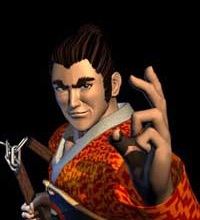
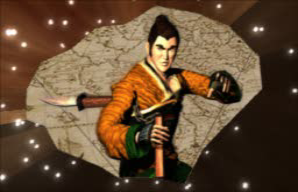
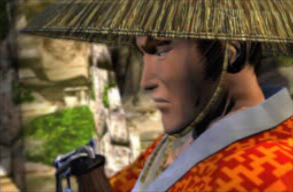
HEISHIRŌ MITSURUGI

Age / Birthday: 22 / June 8
From: Japan
Height / Weight: 168cm / 59kg
Blood Type: AB
Fighting Style: Mitsurui
Weapon: Katana "Korefuji"
(VA: Toshiyuki Morikawa)

A legendary rōnin, he seeks Soul Edge
in the hope of countering the new weapon,
'Tanegashima'- the matchlock rifle.

"Underground
Hunter"
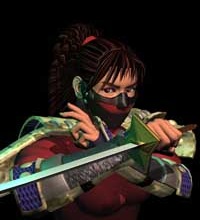
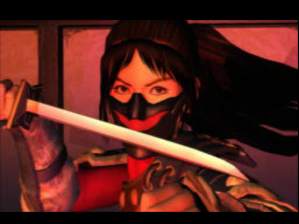
TAKI

Age / Birthday: 22 / Unknown
From: Japan
Height / Weight: 170cm / 55kg
Blood Type: A
Fighting Style: Dream-Slashed Sword
Weapon: Ninjatō "Rekki-maru"
(VA: Fujiko Takimoto)

A strong demon hunter, her beloved weapon
is slowly becoming weaker, so she wants to
strengthen it with the power of Soul Edge.

"Rage of
Executor"
LI LONG

Age / Birthday: 24 / October 23
From: China
Height / Weight: 168cm / 55kg
Blood Type: B
Fighting Style: Matchless Dragon
Weapon: Nunchaku "Snakewind"
(VA: Jin Yamanoi)

Following the Emperor's command to find
Soul Edge, he learns his lover Chie has
been slain by a swordsman, Mitsurugi...?


"Heart and
Soul Girl"
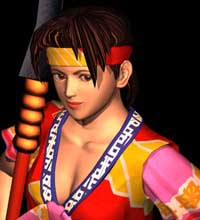
SEONG MI-NA

Age / Birthday: 16 / November 3
From: South Korea
Height / Weight: 159cm / 46kg
Blood Type: A
Fighting Style: Seong's Long Blade
Weapon: Naginata "Zanbatoh"
(VA: Hekiru Shiina)

Defying her father and gender norms,
she wants Soul Edge to fight for her
country and bring about the end of war.

"The Hero of
the Warlike Age"
HWANG SEONG-GYEONG

Age / Birthday: 25 / August 8
From: South Korea
Height / Weight: 171cm / 60kg
Blood Type: AB
Fighting Style: Seong's Long Blade
Weapon: Long Sword "Bluestorm"
(VA: Toshiyuki Morikawa)

Taken in by Mi-na's father and trained in
the way of the sword, he too seeks
Soul Edge for the peace of his country.

"Reckless
Commando"
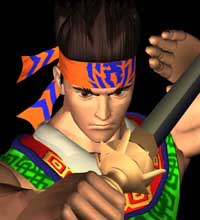
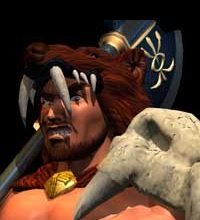
ROCK

Age / Birthday: 35 / December 14
From: New World
Height / Weight: 175cm / 81kg
Blood Type: ?
Fighting Style: Own Style
Weapon: Battle Ax "Apocalypse"
(VA: Takashi Nagasako)

He grew up in the wilds of the New World
after a shipwreck, eventually becoming part of
a tribe. Will Soul Edge return his memories?


"Emotional
Goddess"
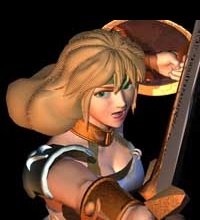
SOPHITIA ALEXANDRA

Age / Birthday: 18 / March 12
From: Greece
Height / Weight: 168cm / Secret!
Blood Type: B
Fighting Style: Athena
Weapon: Short Sword / Shield "Ω / Owl"
(VA: Michiko Neya)

A deeply faithful baker's daughter, she is armed
by Hephaestus, blacksmith of the Gods, and
tasked with ridding the world of Soul Edge.

"Hell
Guardian"
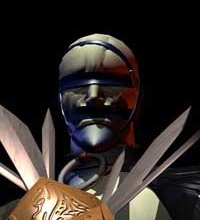
VOLDO

Age / Birthday: 43 / August 25
From: Italy
Height / Weight: 183cn / 79kg
Blood Type: A
Fighting Style: Own Style
Weapon: Katar "Karma / Mara"
(VA: The pit of one's soul)

The blind guardian of his long-dead master
Vercci's 'money pit', he hears his master's
voice telling him to seek out Soul Edge.

"Innocent
Darkside"
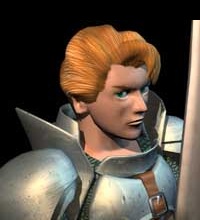
SIEGFRIED SCHTAUFFEN

Age / Birthday: 16 / February 6
From: Germany
Height / Weight: 157cm / 48kg
Blood Type: A
Fighting Style: Own Style
Weapon: Zweihander "Faust"
(VA: Nobuyuki Hiyama)

After killing his father by mistake while
in a band of thieves, he went mad with
grief and now seeks the 'killer' in futility.


"The Immortal Pirate"
CERVANTES DE LEON

Age / Birthday: 48 (Immortal) / January 1
From: Spain
Height / Weight: 177cm / 80kg
Blood Type: O
Fighting Style: Possessed
Weapon: Legendary Sword "Soul Edge"
(VA: Takashi Nagasako)

The game's mid-boss.
The current weilder of Soul Edge, he is
a merciless and undying pirate, ready
to kill anyone who tries to take the blade.

"Inferno"
SOULEDGE

Age / Birthday: ? / ?
From: ?
Height / Weight: ? / ?
Blood Type: ?
Fighting Style: ?
Weapon: Legendary Sword "Soul Edge"
(VA: Takashi Nagasako)

The game's final boss.
Rising from a defeated Cervantes, is this
horrid being the true twisted form
of Soul Edge itself...?


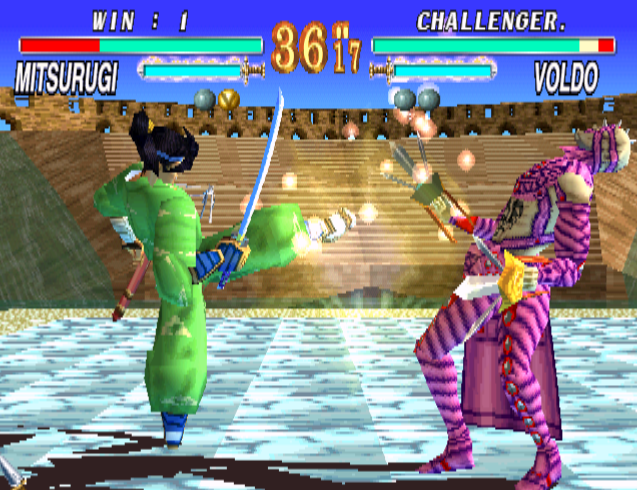
Let's start with the basics then, and much to Capcom's chagrin, the four buttons are identical to the ones found in Star Gladiator that released later the same year. We have A for horizontal weapon attacks (can't be sidestepped but slightly weaker); B for vertical weapon attacks (slightly stronger and overhead so can't be blocked low but easily dodged); K for kicks (weak but can't be Guard Impacted against); and Guard for defending against attacks (no chip damage but your weapon gauge takes a hit). What I'm sure is even more annoying to Capcom is that it even has an equivalent of Star Gladiator's Plasma Reflect mechanic with Guard Impact, essentially a parry that gives the user frame advantage when successful and doesn't consume any weapon gauge, and unlike Star Gladiator, it's not tied to whether it's a horizontal or vertical attack, it's just kicks that can't be Guard Impacted. Yes, you can absolutely get caught in Guard Impact wars where you constantly Guard Impact each other's attacks like you're in a shōnen manga. Yes, it's funny every time. Ahem. It did take them a revision to figure out the best way to do Guard Impacts, but it's a mechanic that's stuck around for pretty much the whole series in some form or another since then, something far more intuitive than the Plasma Reflect that Capcom came up with (although weirdly, characters like Mitsurugi and Sophitia have vertical-only reversals that other characters don't have). It's also very satisfying to land, which is a big plus for a mechanic you'll be using whenever you get a good read on your opponent! Something that doesn't happen quite as often but can come up is a weapon clash, similar to Samurai Shodown but instead of mashing (which doesn't help you), it's janken (as the PAL manual calls it, no really) with A beating B, B beating K and K beating A, weirdly similar to Reversal Edge that'd show up in SoulCalibur VI over twenty years later. It's something that kinda reduces the amount of hit trades you'll have, but it feels more a case of "it sure is there" rather than a game-defining thing, despite what the promotional materials would indicate (they loved showing off that weapon lock!).

From mechanics that'd show up in later SoulCaliburs or inspire them to one that was dropped immediately, let's talk about the weapon gauge underneath your health bar, one of the most striking difference between this and later games outside of the movement tech. This pulls double duties as a guard crush meter as blocked attacks slowly chip away at it but also a super meter as your Critical Edge attacks- essentially super moves that, upon a successful hit, perform a long canned combo you can extend with extra inputs- take roughly a third of it away from you when executed (although you can cancel it if you're quick with G). When it's emptied, your weapon amusingly flies off into space and you're left unarmed for the rest of the round! You can still guard but you'll take chip damage instead (and I imagine it hurts your character a lot, you can't do a blade catch here!). This combines a bunch of things, really- it's a bit risk / reward as you can trade in easy guarding for Critical Edge to get big damage if you land it and rely on riskier Guard Impacts for meterless guarding, and it's also a way of discouraging too much guarding by punishing it without throwing in some Guard Impacts. It might be a smidge too punishing as it never recovers on its own and you only get ⅔ of it back between rounds, but that might just be because I'm the kind of player that loves to throw out Critical Edges when I think I have a chance of landing (I never do) and that's the 'find out' part of the 'faff around' conundrum. I completely get why they later abandoned this mechanic- it's a bit punishing if you're not good at correctly reading Guard Impact opportunities, and it's also a lot of extra work to add a whole new set of moves for unarmed combat. It seems Namco knew that too because everyone shares the exact same set of unarmed moves aside from the women getting slightly different throws, plus they'd come up with other ways to balance guarding and incorporate super moves (including a proper super meter eventually) in later games. That said, it does give the game a unique feel and a stronger sense of danger from guarding too much, encouraging you to be a bit more aggressive and willing to try Guard Impacts to preserve that meter.


As for movement, we have a few elements from Namco's own Tekken with wake-up options for rolling (mash G and a direction, including into the background / foreground), dashing back and forward, full-pelt running with enough distance plus both the big ol' moon jumps and short hops if you don't want to commit to a full jump. There's even character-specific movement options like Sophitia's Angel Step for advancing strikes, Taki's Roll the Bones and Stalker for nimble movement and Voldo's Turn Around that leads to extra moves. The big change here is the inclusion of 3D movement for every character outside of wake-up, a first for Namco fighting games (unless you want to count Knuckle Heads, you silly goose) with tapping Down, Down to move into the foreground and Down, Up to shift into the background. You don't get nearly as much distance here as you do in Star Gladiator so you can't dodge horizontal attacks with it (I had to double-check, in SG your dodge swings so wildly you can avoid such attacks with ease, how weird, huh?) but vertical attacks and kicks are easily sidestepped. However, there's a big delay between dodging and regaining control so it definitely feels awkward and not as buttery-smooth as the movement would become after the introduction of eight-way movement to the series. It's an early step forward for Namco and it even beat Sega to the punch, with them only implementing a sidestep in May 1996 with Sonic the Fighters (although I'd argue Sonic the Fighters did it better), but it is something you get used to with practice, just learning when you're actionable afterwards is the key. Speaking of movement, this also has Ring Outs similar to Virtua Fighter where you'll win the round if your opponent falls out the arena but crucially, you can't accidentally ring yourself out with a move that sends you moving forward or intentionally step out by yourself, you have to be attacked in some way to fall out. That's a lot more lenient than some games that use them! Sadly you can't join your opponent out of the ring in solidarity afterwards (that shows up later in the series) but not having the threat of easily ringing yourself out is much friendlier to the player, even if that does lead to unintentional comedy in other games.

Now that we've got the basics down, if you've read our fighting game articles before (you poor soul) then you'll know what I like to do here is lay out the mechanics as succinctly as I can (you can't hear this but my editor just did a hideous cackle, like a witch does as they drop more eye of newt in their cauldron) then figure out what kind of fightgame it makes when it's all put together. Figuring these games out is the fun part for me, silly as it sounds! When it came to doing this with Soul Edge, it occurred to me that this is an interesting case where it's not so much throwing a load of new ideas at the wall and seeing what sticks like Star Gladiator or making gigantic strides forward in uncharted territory like Virtua Fighter, but instead taking bits and pieces from other games- ring outs, sidestepping, weapons and being disarmed in battle- and executing those ideas very well in a single package. For the most part, the movement and the attack animations are smooth and natural-feeling, especially impressive given that everyone's wielding different weapons, attacks feel nice to string together with not a huge amount of recovery frames like in Star Gladiator, and the Guard Impacts and sidestepping (as awkward as those sidesteps can be at points) give you an incentive to not become too predictable, to bait your opponent into committing to something and then counter-attacking. It never gets quite as tense or nerve-wracking as something like Samurai Shodown II where a single wrong move can shred your entire healthbar, but it does 3D weapon fighting with a high level of polish, as you'd expect from Namco. Some of the inputs and movements can feel a little stiff- some kick combos come off as pretty awkward (thinking of Sophitia's main kick combo here, that one feels the most like a Star Gladiator combo) and again, the sidestepping can feel off- but it feels a teeny-tiny bit more lenient than the other Namco fighters of the time (some of those inputs in Tekken 2 are rough, especially combo throws) and they'd only improve from here.


This is all absolutely bolstered by the graphics and sound which are thoroughly excellent, really showing what Playstation-based hardware can do when pushed. The character designs in this first outing are all great and memorable with most of them going on to become staple characters of the series and the character models move smoothly with weapon motions that feel suitably authentic even with some of the wilder moves available. They have that certain Playstation 3D model look to them as opposed to the clean-as-hell polygons of Model 2 games, but they do a great job of conveying the heft and weight of the weapons they're using, and they even have different expressions and moving mouths when talking and taking damage. A very strong presentational point is in the form of the stages, which feel like miniature worlds in and of themselves, far closer to what Sega was doing on Model 2 with Virtua Fighter 2 and Fighting Vipers than the infinite scrolling and matte painting background approach of the Tekken games, complete with a stunning day-night cycle that not only alters the lighting and entire feeling of the environment, but even changes where the shadows of the characters are cast! The most impressive stage is probably Li Long's raft ride through a canyon, which I have to wonder may have been Namco saying they could do Shun-Di's similar stage in VF2 too, but the other stages are just as great-looking, with personal favourites including Sophitia's ethereal, colour-cycling temple, Taki's haunted shrine with ghosts floating about and Cervantes' platform in a port town that leans and bobs in the water. One especially nice touch is that the ring-out can change depending on the stage- falling out of Mitsurugi or Siegfried's stage just has you flop over a few inches, but you'll take a huge spill out of Sophitia and Rock's stages with a shuddering thud, and even fall in the water in Li-Long and Cervantes' stages!

The sound is great too, with suitably-satisfying slashing sounds accompanying the action as well as very clear clanging and clashing to accompany blocked attacks so you can easily tell the two apart, and the soundtrack is thoroughly excellent, with The Wind and Cloud and Recollect Continent being particular favourites from the Takayuki Aihara and Takamori Otsuka soundtrack. One thing that is a little odd for me is the voicework. Namco's fighting games weren't quite as talkative as the likes of Virtua Fighter in these early days, but Soul Edge is particularly weird for me specifically because I'm so used to the rerecorded voicework for the Playstation version. That means a lot of classic lines (in English!) aren't present in this original arcade game. So, it just feels really strange to me to go back to this arcade version! What's there is good though, and more importantly, Barry Gjerde provides the voice for the very first narrator in the Soul series. The series would go on to have narrators that set the stage before each battle, but while here his commentary is mostly limited to announcing each round as a 'battle' and the post-round report of 'The gruelling battle ended with the victory of [Name]' or '[Name] stood again against an impossible enemy' but it adds a little bit of charm and, dare I say, gravitas to the fights- this isn't some tournament, these warriors are fighting for their own causes, to claim the cursed sword or destroy it, and his narration adds to that. Best, of course, is when you coin up, you hear his now-legendary 'Transcending history and the world, a tale of souls and swords, eternally retold' which couldn't set the scene better if it tried. Fantastic presentation all around, then.


After release, Soul Edge would go on to have a fantastic Playstation port that we'll talk about later and become a staple of anyone's PS1 collection, but a few years later would give way for another technological breakthrough. SoulCalibur, which began as an experiment with an eight-way movement mechanic that evolved into a mechanic still with the series today, would release about two years later on the still-PS1-based-but-improved System 12 hardware and go on to have five more sequels and a spin-off or two, leaving Soul Edge behind. You'll see this in YouTube videos where people go through the entire series and spend as little time as possible with this first game, as if it's a historical footnote and not much else and that's a real shame if you ask me. My main point here is it feels like a distinct game from the later ones in the series- in a 1999 interview in the Legend of SoulCalibur art / design book as translated by shmuplations, design lead Koh Onda explains that, "we only ever positioned the game as a sequel to Soul Edge in terms of setting and story; as far as the core game goes, we introduced a lot of new ideas, and by the end of development, we ended up redoing the majority of the animation from scratch. In that sense, the game wasn't developed as a sequel to Soul Edge... so from that perspective, we were able to treat it as a completely separate project." and I mean, that last part really sums it up, doesn't it? A completely separate project that evolved into its own series is a good way to see SoulCalibur and also give Soul Edge its own identity.

Going on from that, I feel that Soul Edge has a distinct 'flavour' with its unique weapon gauge mechanic and, yes, less sophisticated movement mechanics, and I think it works pretty well- the most telling thing is that even after a long time of not playing it, Soul Edge is a game you can just jump right back into and it feels good. Maybe this is because of all the time I spent learning Star Gladiator and just getting nothing out of it, but when I went back to Soul Edge after playing that it felt so much smoother and more fun to play, and even later after playing a lot of early Tekken, Soul Edge felt so easy to get back into, do some string combos, a cheeky little Guard Cancel here and there, kick some dudes in the ghoulies with Sophitia's grab, you know, the normal things. The main thing I want to get across here is that sometimes, especially in the world of fighting games, it's not just a linear path of a sequel being better than the game that came before it, and the first entry in a long-running series has value too. There are many cases of sequels just doing things better of course, but what I want to do with this article I guess is just highlight that Soul Edge has its own qualities, its own flavour, and shouldn't just be in the shadow of SoulCalibur, you should give it a try, maybe with a friend and have some fun with it. Play fighting games! From the first in a series to the last! That's what it's all about, really, isn't it?

For standing again against an impossible enemy, Soul Edge is awarded...

In a sentence, Soul Edge is...
A brilliant first stab at weapon-wielding in 3D.


And now, it's that time, folks!
EXTENDED PLAY!


First up, an early preview video of Soul Edge with quite a few differences from the final game.

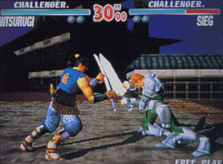
The description on this upload is a little vague, but it mentions that it was shown at a "AOU arcade game show in Japan in 1995". I think this might be a mix-up- the AOU Show '95 was held in February that year and contemporary coverage from the likes of Saturn Fan and EDGE make no mention of it, but Computer & Video Games mentioned the game in an article about the Amusement Machine Show '95 which as we saw earlier was September that year. So, it's probably that show and not the AOU Show '95. Anyway, there's some pretty interesting differences here- some character names are different (Sieg instead of Siegfried,Sung instead of Seung used in the original game), several sound effects like hitting sounds are different, Epic Calling is missing its melody, and most of all, Li Long has a completely different idle stance and is bald! He'd go bald for his 2P outfit in the final game, but his idle animation was definitely improved for the final game.


There's also a few prototype screenshots to see on the various flyers, including on this Namco AOU 1996 leaflet and this US one for Soul Edge Ver. II. I've picked these two out in particular as they help highlight the big differences and that there's two different builds being shown here. The first one shows a red timer in a bolder, more modern-looking font (and the timer only ever shows 30.00 or 00.00, never anything inbetween) and Siefgried's name under his lifebar as Sieg again, and the second one shows a different font for the character names with a gold chrome look to them. More importantly, both of these screenshots, and many of the others on these flyers, don't have the weapon gauges yet! There's just a conspicuous gap where they're supposed to be. Weird to see the game without 'em!


Next, we mentioned a few differences between Soul Edge and Soul Edge Ver. II, but here's a table of what we could find.

At the very least, we've got a bit of a leg-up in this regard as the operator's manual for Soul Edge Ver. II helpfully lists most- albeit not all- of the changes. So we used that as a base, then tested a few things, made a few calculations, used our eyes to spot some differences, and here we are. If there's any others, let us know!

General

Soul Edge Soul Edge Ver. II
Eight characters are selectable:
Mitsurugi, Taki, Li Long, Seong Mi-na, Rock, Sophitia, Voldo and Siegfried.
Cervantes and SoulEdge are unplayable bosses and Hwang is a secret character.
Ten characters are selectable:
Mitsurugi, Taki, Li Long, Hwang, Seong Mi-na, Rock, Sophitia, Voldo Siegfried and Cervantes.
SoulEdge is an unplayable boss.
Each character has a Player 1 and Player 2 outfit, with one colour each.
Hold G to switch between the two outfits.

Each character (except Cervantes) has two costumes with two colours each- one for A, one for B.
Hold G to switch between the two outfits.
(Cervantes has four colours for the same costume)
Solo players only have the standard arcade mode against randomised opponents
The exceptions are Cervantes (Stage 9) and SoulEdge (Stage 10).
Holding A + B + K before pressing Start enables Time Attack Mode with opponents in a set order.
Players get detailed statistics upon finishing the game.
SoulEdge is a tough boss fight, as he repeatedly uses his dashing attack, Self Destruction, with impunity. SoulEdge has been toned down to be less aggressive, using Self Destruction much less often.
When playing against another player, stages will cycle through this order upon power-on:
Seong Mi-na, Taki, Li Long, Voldo, Sophitia, Seigfried, Rock, Mitsurugi.
The stages for Hwang, Cervantes and SoulEdge will never appear in this cycle.
When playing against another player, stages will cycle through this order upon power-on:
Seong Mi-na, Taki, Li Long, Voldo, Sophitia, Seigfried, Rock, Hwang, Cervantes, Mitsurugi.
The stage for SoulEdge will never appear in this cycle.

Gameplay Mechanics

Soul Edge Soul Edge Ver. II
Only Taki, Seong Mi-na, Siegfried, Cervantes and SoulEdge have unblockable attacks. Every character has an unblockable attack.
Only Rock, Sophitia, Seong Mi-na, Voldo, Siegfried, Cervantes and SoulEdge
have Down or Down-Forward + B upswing attacks.
Every character has a Down or Down-Forward + B upswing attack.
It is also slightly easier to hit opponents in the air with these attacks.
A Guard Impact is performed by pressing G just as a weapon attack hits you.
This is similar to Just Defend from Samurai Shodown II.
A Guard Impact is performed by pressing Forward + G at the same time.
This means it is now possible to 'whiff' it.
Blocking a normal attack consumes roughly 8% of the Weapon Gauge.

Blocking a normal attack consumes roughly 10% of the Weapon Gauge.

Using a Critical Edge attack consumes roughly 38% of the Weapon Gauge.
With a full gauge, you can use two Critical Edge attacks.

Using a Critical Edge attack consumes roughly 30% of the Weapon Gauge.
With a full gauge, you can use three Critical Edge attacks.

Critical Edge attacks are a commitment and cannot be cancelled once performed. Critical Edge attacks can be cancelled with G early enough in the startup animation.
Critical Edge attacks can only be performed from a standing position. Critical Edge attacks can also be performed when backdashing.
If a Critical Edge attack hits a short-hopping opponent,
one hit will land before they hit the floor.
If a Critical Edge attack hits a short-hopping opponent,
they will be juggled for the whole combo.
Throw and Critical Edge attack inputs are quite strict. Throw and Critical Edge attack inputs are slightly less strict.

Graphics & Presentation

Soul Edge Soul Edge Ver. II
The 3D Namco logo sequence has a light blue gradient background.
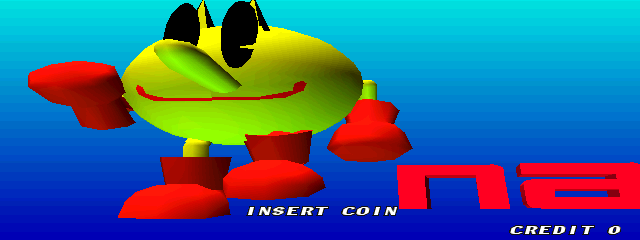
The 3D Namco logo sequence has a dark blue gradient background.
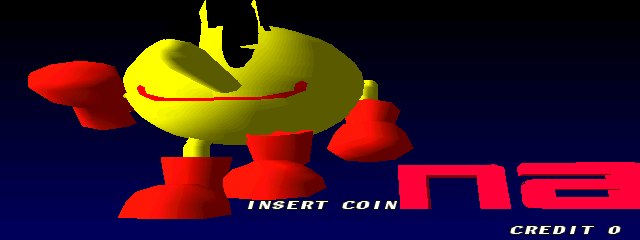
The attract mode has a short FMV sequence zooming in on the Soul Edge logo. The attract mode cuts quickly between one of the playable characters and the zooming-in FMV.
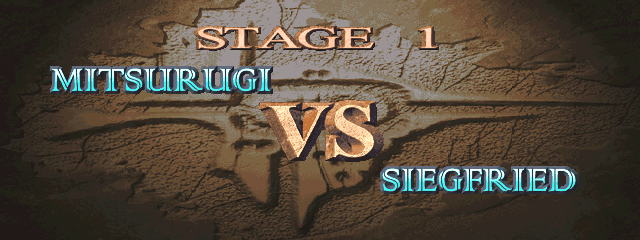
The versus screen shows the character names and the stage number.
The background, also used on the character select screen, is tinted brown.
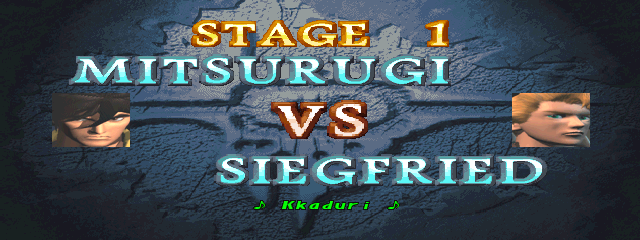
The versus screen shows the character names, character portraits, stage number and song name.
The background, also used on the character select screen, is tinted blue.
-
Many stages have different lighting that very slightly changes colours of things like buildings.
Some stages have more major changes, listed below.
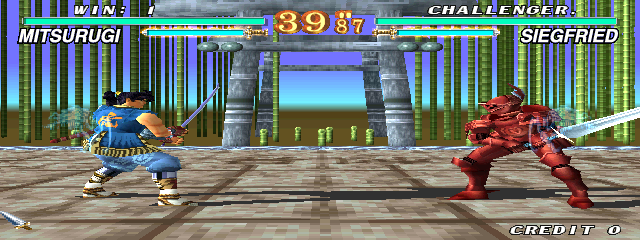
Taki's stage has a black sky that never changes.
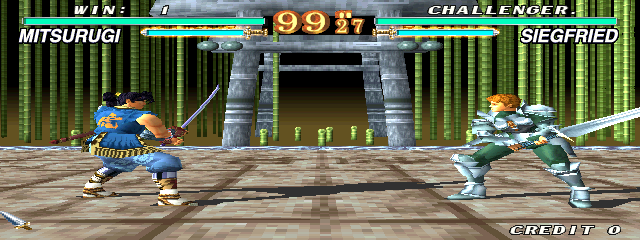
Taki's stage has a gradient sky that changes with the time of day as with other stages.
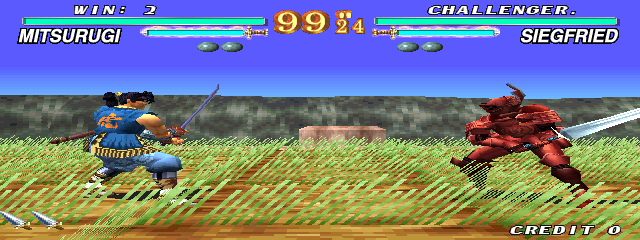
Rock's stage has brown grass, dark-brown ground and brown cliffs in the background.
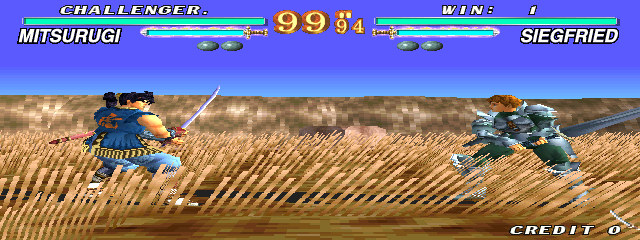
Rock's stage has green grass, light-brown ground and dark-green cliffs in the background.
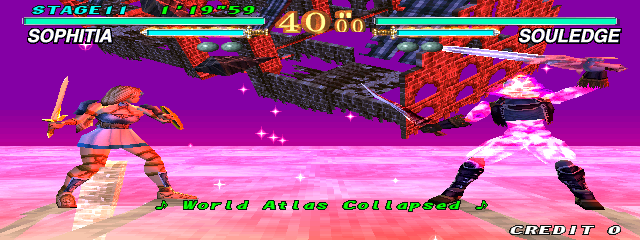
SoulEdge's stage has a gradient sky background- pitch-black at the top, moving to dark blue to purple to red.
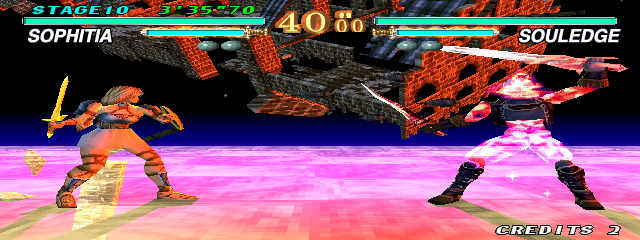
SoulEdge's stage has a gradient sky background- purple at the top, moving to pink.
Sophitia's skirt is plain white.
Her underwear can't be changed.
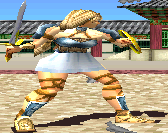
(If you peek...
Sophitia's skirt has added pleats and a blue highlight and the bottom.
Her underwear can be changed with a cheat.
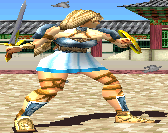
... then Rie Kugimiya will scold you.)


There's a few secrets in the arcade versions of Soul Edge, so let's take a look.


Exclusive to the first version is a secret fighter, Hwang Seong-gyeong (originally romanised as Hwang Sung Kyung).

As detailed in SHamilton's guide on GameFAQs, there are two different codes to play as Hwang, depending on your player side:
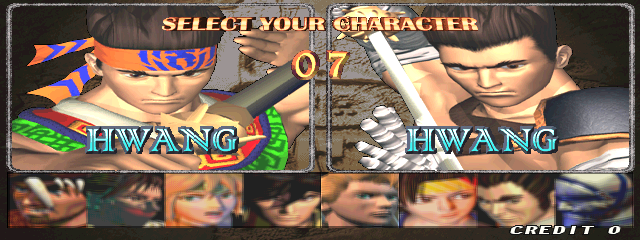
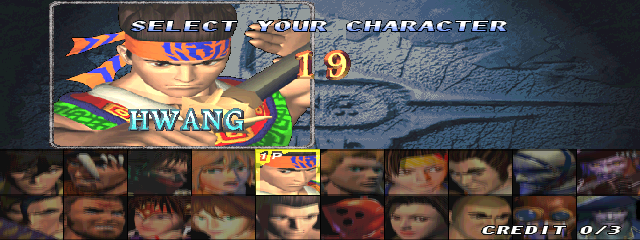
Player 1: After inserting a coin, hold down Start then on Mitsurugi (where your cursor starts), press Up, Down, move left to Taki then press Up, Up, Down, Down, move left to Rock then press Down, Up, Down, Up. After successful entry, a short jingle will play, so move left to highlight Hwang.
Player 2: After inserting a coin, hold down Start then on Siegfried (where your cursor starts), press Up, Down, move right to Li Long then press Up, Up, Down, Down, move right to Voldo then press Down, Up, Down, Up. After successful entry, a short jingle will play, so move right to highlight Hwang.

Hwang's a bit of a strange character to make a secret though. His moveset is mostly the same as Mitsurugi with a very small amount of changes- most of his A and B attacks are identical as are his throws but he gets some different kick attacks like a three-kick string (forward, forward, KKK) and a slightly different sweep and a different ender for his Critical Edge (half-circle back, AB). When he was promoted to a non-secret character in Ver. II, he got a few more changes to make him a little more distinct (and of course a new unblockable like everyone else) but it's still a little weird, huh?


... Now, I know what you're thinking, oh yes, a famous piece of Soul Edge trivia, Hwang was a replacement character for Mitsurugi for the Korean release of the arcade game. I thought that too. It was one of those facts you just knew, you know? It was on Wikipedia, frequently cited on fan Wikis and the like, but... Turns out it's a tissue of lies!! I'm being a little melodramatic of course, just for the bit, but there is no proof a 'Korean version' of Soul Edge exists that replaces Mitsurugi with Hwang. This was pointed out by noted Arcade Knower ohfivepro, whose thread explains that Japanese games were illegal unless they were handled by a Korean company, and so few Japanese companies went to the trouble outside of examples like SNK (hence releases like The Last Soldier and Fighters Swords). There are examples of Asian-region ROM sets of arcade games removing Japanese elements like voice clips or songs Marvel vs. Capcom's Asian revision turns Kaze yo Tsutaete..., Roll's theme, into an instrumental) but they're for regions of Asia that aren't Japan and not specifically Korea, so maybe some companies were just hedging their bets in case a few grey imports or bootlegs made their way over.

Anyway, back to the matter at hand. ohfivepro dug through issues of Game Champ, a South Korean games magazine that did pretty extensive arcade game coverage, and found for us pages that strongly suggest no Korean version existed. The short move list they have for Soul Edge in their March 1996 issue (Page 162 in the scans, 159 on the archive viewer) shows Mitsurugi and not Hwang, and they cover the cheat to play as Hwang in their July 1996 issue (Page 163 in the scans, 139 on the archive viewer). Why would Korean players need that cheat if the Korean version was out there? To be honest, I was a tiny bit suspicious about it all when I noticed Soul Edge has an Asian ROM dumped with no character swaps and that no Korean ROM appeared to exist, but I should've listened to my gut! As for how that rumour even started in the first place, my guess is that SoulCalibur is to blame- Asian ROMs of that game (which do exist and are dumped for use in MAME) replace Mitsurugi with Arthur, a pirate with an eyepatch, and so perhaps people retroactively applied that to Hwang because he has the same moves as Mitsurugi, unwittingly creating a false fun fact that spread around the internet unchecked for decades.

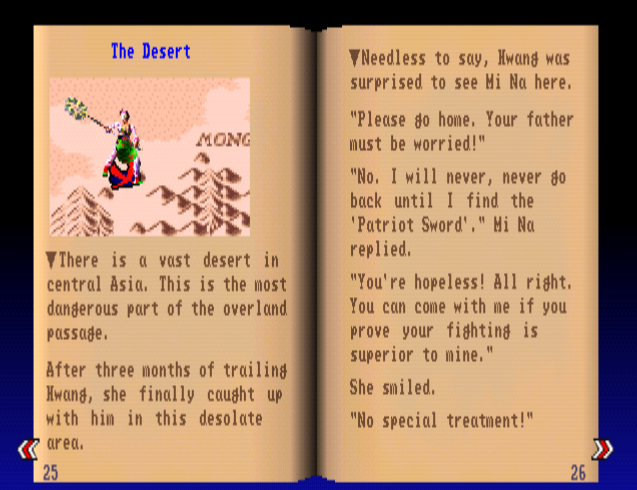
Well, mostly. There's a few little details that don't fully add up. For one, Hwang's stage. The Desert, is in the code for the first version of Soul Edge but doesn't come up in the rotation for versus play nor does he ever show up as a computer opponent so there's no way to see it wtihout MAME cheats. Additionally, Soul Archive has an image of the flyer key art edited to replace Mitsurugi with Hwang, and the caption on the page calls it a "Korean (Asian) version poster". Do they mean 'a poster for the Korean version of the game' or 'a Korean version of the poster'? Language is fun! There's a similar piece of Tekken 2 promotional art that, according to Katsuhiro "Don't Ask Me For Shit" Harada himself, was changed at the request of "a Korea distributor" to have Baek Doo San replace Jun Kazama, and the Service Mode of Tekken 2 also has an option to replace Jun with Baek as a standard character on the select screen. The service manual for Soul Edge Ver. II (a second link just in case, lots of copies keeps stuff safe!) shows an option labelled "New Character" with Mitsurugi as the default, but there's no such option in any dumped revision of the game. So I wonder now if the plan was to replace Mitsurugi with Hwang but it was axed last-minute, and Hwang was left in as a secret character instead? In any case, I'll say it again, there is no solid evidence of a board revision outright replacing Mitsurugi with Hwang ever existing. Of course, it's hard to prove a negative so I'll happily eat crow if a Korean revision shows up alongside an English board of Märchen Maze called Alice in Wonderland, an English board of SegaSonic the Hedgehog that isn't a fan-made thing and both Don Bear-Near and Rhinoceros Bar Command. Those are jokes for no-one.


The closest you get to this is in the Asia ROM of Soul Edge Ver. II, shown above.

As well as showing the alternate costumes as a second row, Mitsurugi and Hwang swap places, with 1P defaulting to Hwang on coin-up.


Back on topic... A code added in Ver. II is the time-honoured fighting game tradition of a weird secret revolving around underwear!

Holding one, two or three buttons out of A, B and K before a battle begins will change the colour of Sophitia's, erm, knickers, with a total of eight colours (including the default) for each of her two outfits. What colours are they? Gaming Hell could tell you, but just like her weight, that's Sophitia's business, not yours. This also works in the Playstation version, even for her third outfit and for Seong Mi-na's third outfit too, and the cheat also showed up in SoulCalibur, although it was cut from the international Dreamcast versions alongside Voldo's cod-piece outfit.


There is, of course, only one home port of Soul Edge, but it's a doozy- the Playstation port from 1996 (Japan as Soul Edge) / 1997 (US / Europe as Soul Blade).


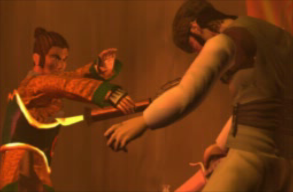
Since the original arcade game was on something pretty close to Playstation hardware anyway, this makes the move fairly seamlessly. Based on Ver. II with Hwang and Cervantes and all the other changes accounted for (some places mention vague 'balance adjustments' but I've never found any more concrete info on this) this is the arcade game at home but with a lot of extra additions, similar to the Tekken ports to the system, but one mode in particular might be even more expansive than the extras found in those games. Of course, the only place to start is the FMV intro, which shows just how far Namco had come in making convincing-looking humans in CG form- the intros and endings for the first Tekken in 1994 look pretty darn goofy but by late 1996 they'd really masstered it, with characters that move as close to real-life as you can reasonably experct for the era, with even a few little action setpieces thrown in for good measure, complete with the legendary vocal song, THE EDGE OF SOUL (a song I only need to type the name of to get you humming along, but here it is anyway) by KHAN who were also behind the Khan Super Sessions soundtrack, one of three selectable OSTs for this version (with the original Arcade and a souped-up Arrange soundtrack both available too). Unlike the Tekken ports, this only uses FMV for the intro but the all-new endings for Arcade Mode are done in-engine which adds an extra wrinkle- alternate endings which you can see with certain button inputs when the cinematic borders at the top of the screen disappear, although the best one is of course the one for Mitsurugi which briefly turns the game into a first-person shooter.


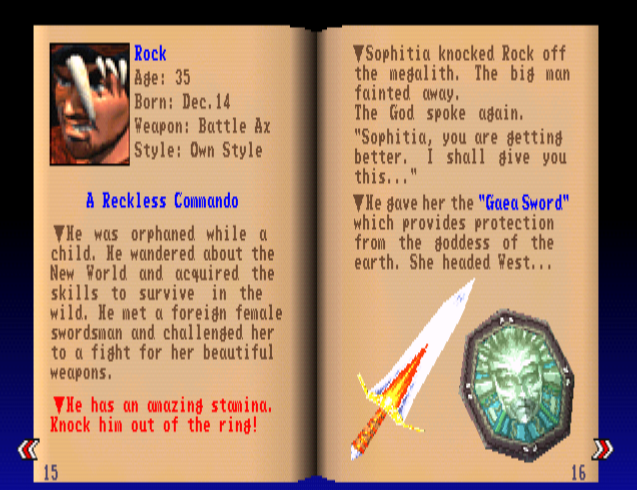
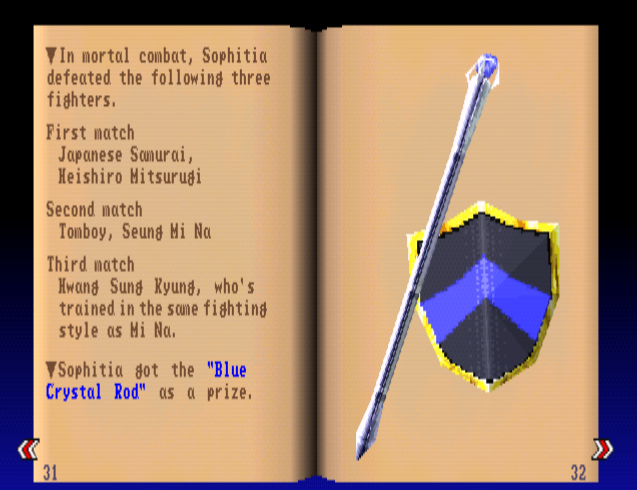
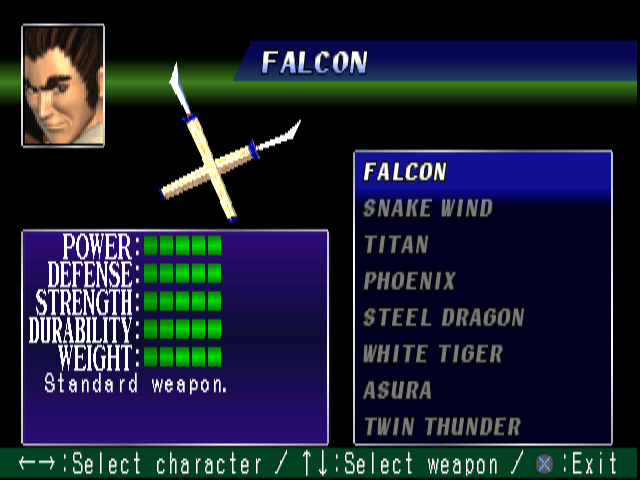
There's also a bunch of extra modes, many of which were becoming standards in fighting game ports at the time- Time Attack (exactly as in the arcade game), Vs. Battle (fight against a friend with options for handicaps and record-keeping), Survival (last as long as you can on a single healthbar with only slight recovery between bouts) and Team Battle (select up to five characters, last one standing wins) and, most importantly, Edge Master. Choosing one of the ten main characters, you journey across the 16th Century world, with a book chronicling your character's story, step by step. Each episode has you fighting a battle, often with new stipulations or twists that tie in with the story itself- if trawling to the bottom of Vercci's Money Pit weakened your character, that means you fight Voldo starting with less health; if Seong Mi-na's dad is still hot on her trail, she'll only have a short amount of time to defeat her next opponent; if your character joins a fighting tournament to win the prize, it's an endurance match for you. Just having even a tiny bit of in-universe justification for things like "your enemy recovers health" or "your health is constantly draining" really adds a lot of flavour to the story. There's some genuinely great bits of story-telling here too, like you visibly see Siegfried descend into madness and despair as his futile quest goes on, and at one point Mitsurugi stops to count all the people who might have grudges against him (he has to stop as there's too many). As you fight, you'll gain brand new weapons with different properties like recovering your weapon gauge, faster attacks or even health-sapping ones (and the silliest one, Hwang gets a gigantic invisible sword) that can be used in other modes too, with one 'secret' weapon you'll have to find after beating the game with your character. I think Kimimi's blog does a better job explaining the appeal of this mode (and the little touches in the port as a whole) so definitely give it a read.


We're not done just yet though, this game also adds a few extra playable characters, costumes and even stages, with methods taken from GameFAQs. First, all of the standard characters have a new third outfit selected with K (these were part of a design contest, and the winners' names are in the credits) and two new arenas have been added with an Asia stage (standard ring size) and larger Colosseum stage (only appears in Vs. Battle if the ring size is set to 20M or higher) with new music (even done in the arcade game's music style!). For characters, SoulEdge is playable for the first time by either beating Arcade or Time Attack with every standard character or play the game for a total of 20 hours, and he even gets a unique ending in Arcade Mode; Seong Han-myeong (Seong Mi-na's dad and Hwang's teacher) is an opponent in Hwang's Edge Master story and becomes playable if you unlock SoulEdge, then complete Arcade with Hwang and then again with Seong Mi-na. He's just a model swap but he does have his own voiceclips and victory animations at least. Finally, treated as separate characters but mostly being alternate costumes, Siegfried! (his nightmarish form from his standard ending) is unlocked by getting all of Seigfried's weapons in Edge Master, Sophitia! (her 1P costume without the armour) is unlocked by getting all of Sophitia's weapons in Edge Master; and Sophitia!! (a bathing suit) is unlocked by getting all 70 weapons across everyone's story in Edge Master.


As for what's missing from the arcade game, there's not a whole lot but there are a few things omitted here and there. The main thing is actually the announcer- while he's still very much in the game, a few of his voice clips don't come back from the arcade game. Surprisingly, "Transcending history and the world, a tale of soul and swords, eternally retold" (heard upon coin-up) only plays in the FMV intro, using a different take so the original isn't heard. The attract demo in the arcade game had gameplay without music and would have the announcer say a different phrase each time, such as "The fates conspired to arrange their battle", "A hero desires a sword, and a sword desires truth" and "The mists of darkness swirl around" (this one, alongside "Place your noble soul inside this sword" is also used when you lose against CPU Cervantes and SoulEdge). The PS1 version plays music instead and none of these phrases are ever used. They also fixed the announcer clip for Voldo, as the arcade versions used the pronunciation "Vorudo" (not the last time this'd happen either, it happened in SoulCalibur too). Let's see, what else... The FMV showing the logo being zoomed in on is also not here, but the scene of the character looking around and attacking the camera is used for Edge Master's intro which is a nice touch. Oh, the 2P Cervantes render on the character select screen, as well as his palettes, are replaced with a brand new 2P outfit so these don't reappear either, plus the song titles The Wind and Cloud and The Madness Gears being corrected to The Wind and Clouds and The Gears of Madness. That's... Pretty much it really, and aside from some loading times which are pretty short all things considered, it's the arcade game at home. That's by design, of course, considering the System 11 specs, but it's still an excellent home version of a contemporary arcade game with Edge Master Mode alone being such a great addition that something similar to it showed up in almost every subsequent game. It's the good stuff, is what it is, but sadly this version has never been rereleased since outside of Greatest Hits / Platinum / Playstation the Best / PSOne Books reissues on PS1.


There's actually so much to talk about with the Playstation port that we've got to have multiple sections!

Next, we need to talk about peripherals, and the surprising amount that this port's compatible with.


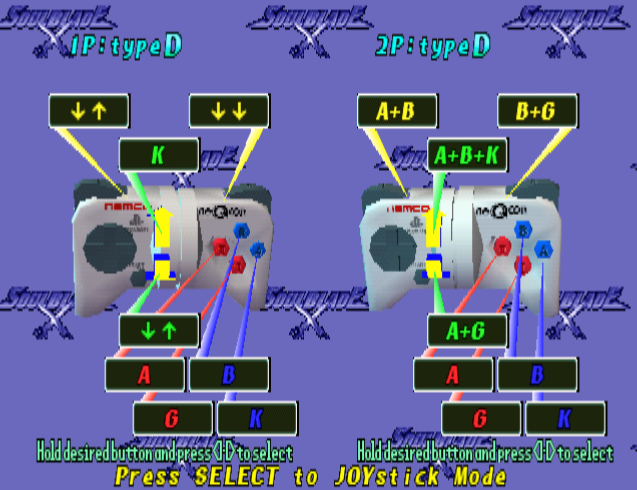
Everyone jokes about how SoulCalibur on the Dreamcast can be played with the fishing rod controller, but fewer know that Soul Edge was innovating in this regard several years prior! We'll start with the one that's mentioned on the back of the box- Namco's neGcon, a controller with four face buttons, two shoulder buttons, a Start button and the most interesting part, the ability to twist the controller forwards and backwards for fine analogue movement, works with Soul Edge. If you've plugged one in, a 3D model for it even appears on the Key Config menu! The suggested use for this is to assign dodging in and out of the screen to twisting down and up respectively, which I imagine feels pretty nice. I can't test it myself as I don't have one of those controllers...


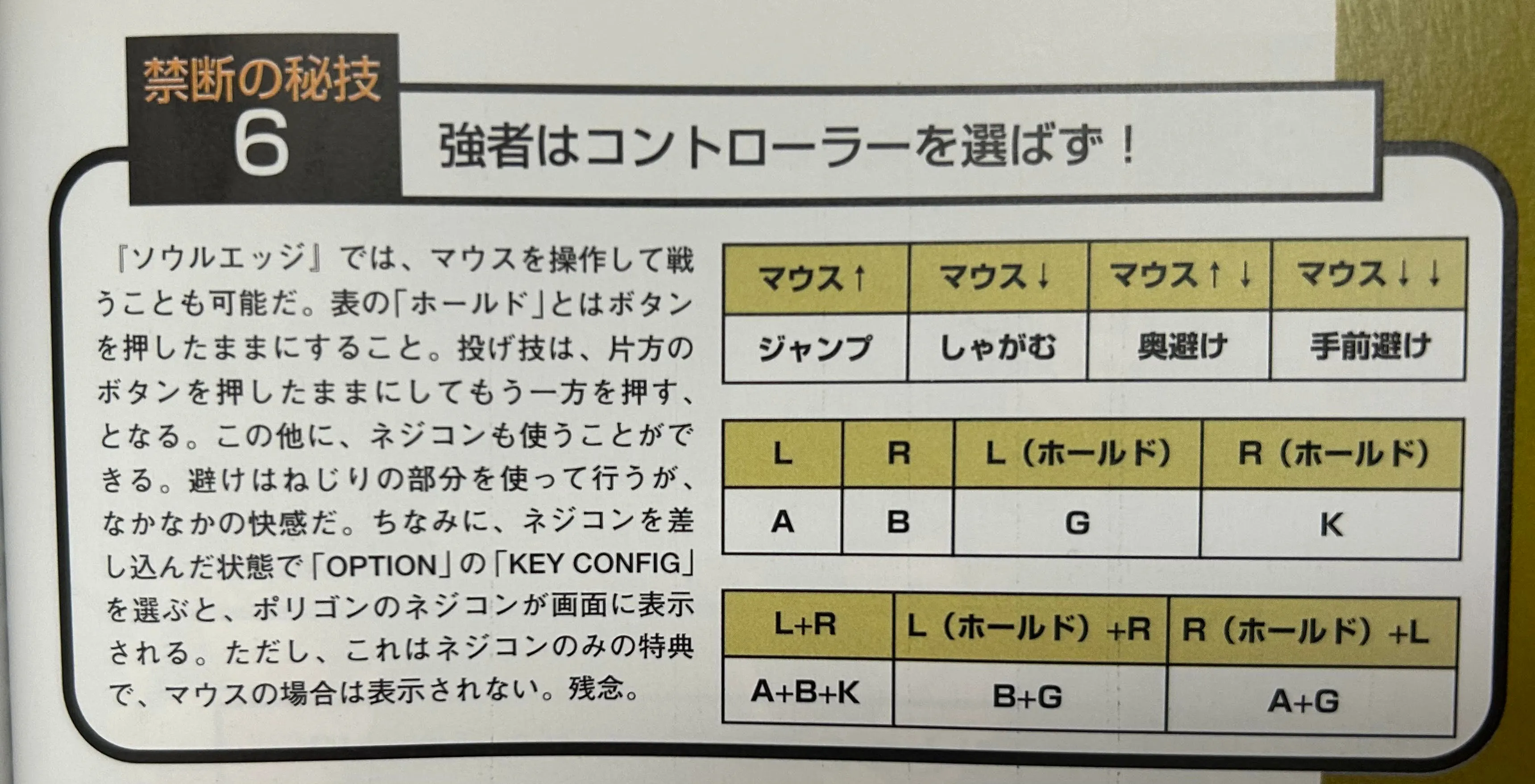
... But I do have a Playstation Mouse, which Soul Edge is also compatible with! No, really. Soul Edge Official Guide Book: The Book of Legendary Weapons (ISBN 4-89366-687-8) has a section on secrets in the Playstation version and you can see a photo of one of them above. Very roughly speaking, this explains how you can use a Playstation Mouse to play the game. Moving the mouse obviously moves your character (with jumping, crouching and both directions of sidestepping accounted for), and attacks are done with clicking- left-click for A, right-click for B, hold left-click for G, hold right-click for K, both at once for A+B+K, hold right-click then press left-click for A+G and hold left-click then press right-click for B+G. This isn't an ideal way to play the game, like, at all- kicks are especially hard to execute and you'll be frantically moving your mouse a lot- but this doesn't seem like a case where the game's reading it as a normal controller and it works that way, I imagine they had to add things like checking if the mouse's buttons are being held for inputs. That's going the extra mile. You won't find Soul Edge on the list of Playstation Mouse-compatible games, so hopefully this website helps change that.


There's one more accessory you can use with Soul Edge that's also not listed on most lists of games compatible with it, even though I figured it was a fairly well-known feature- the Multitap. No, you can't have four-player versus matches, but plugging a third controller into one of the slots of an inserted Multitap- the main places I saw this mentioned, including Soul Edge Official Guide Book and ruyeyama's Secrets Guide on GameFAQs say you have to insert the third pad into Branch B, but I don't have a Multitap to test on real hardware and in Duckstation it works when you insert it into Branch D instead, I'd love to confirm this if anyone else knows!- allows you to move the camera. Pressing R1 or R2 cycles through six different camera styles- the standard one, the standard one with a movable character, first-person views for Player 1 or Player 2 and focused views on Player 1 or Player 2- and in all views except the standard and first-person ones, you can use the directions to move the camera and Square and Circle (default settings) to zoom the camera in and out. Is this necessary? No. Is it fascinating that Namco went to the trouble of even adding it? Yes.


There's also some big regional differences with this port- first between the Japanese and Western versions, then between the US and European version.

The name is the big one, and so we finally have to invoke Tim Langdell on this website. Do not be alarmed by the sound of thunder and lightning upon the mention of that name, that's normal. If you're unfamiliar, Tim Langdell is the CEO of Edge Games whose Wikipedia page is mostly full of details on legal proceedings about the trademark of the word 'edge' which is still a going concern apparently as of May 2026 as he's still after Mobigame's mobile game EDGE, something that's been going on for 17 years. Can you guess where this is going? Contrary to what you might think, Langdell seemingly didn't take Namco to court or anything (he'd actually wait until 2001 to dispute the arcade game's trademark but this was rejected) but Namco wanted to avoid the headache entirely (I'm not an expert by any means on the subject but I think the EDGE Magazine dispute with Langdell was ongoing at this point in time) and so they renamed the home port Soul Blade outside of Japan, and then to avoid the whole legal quagmire in subsequent games by renaming the series SoulCalibur and restarting the numbering. This had the knock-on effect of removing a title call by the announcer, as well as a little easter egg, where holding the shoulder buttons and either Up or Down before the title screen loads gets Seong Mi-na or Cervantes to read out the game's title. Oh well.


The rest of the game's content is pretty much kept as-is with one major exception, the FMV intro.

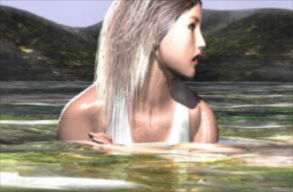
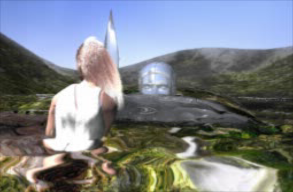
The scene of Sophitia in the water meeting Hephaestus is edited to give her a swimsuit rather than being naked.

Hover your mouse over to see the difference- Western version on top, original JP underneath, just so this page doesn't load with a gigantic butt on-screen for you.

... So Taki's skin-tight bodysuit remains unedited but Sophitia's butt was too much? What the heck? I don't get it.

... As I was writing this, The Cutting Room Floor's page updated with new info that I missed. Yep, sounds about right, good work!


Here's what you're really here to see though, the edits to the PAL version! One of the more infamous Europe-exclusive edits of the time period, Soul Blade was submitted to the British Board of Film Classification- not a required process at the time as games were given suggested age ratings by ELPSA (which still exists but under the name Ukie), but as is my understanding if your game had something the BBFC wouldn't approve of, you'd be likely to get in legal trouble- and it received a 15 certificate, quite high for a fighting game that wasn't Mortal Kombat. More importantly though, at this point in time, James Ferman was in charge of the BBFC and he had a bone to pick with certain weapons. Or, rather, a nunchaku to pick. This is all detailed in a Tedium article with a focus on what they had to do to Teenage Mutant Ninja Hero Turtles over in the UK, but to summarise, Ferman had a focus on eliminating the glamourisation of weapons like butterfly knives and, most famously, nunchaku appearing in media, especially those aimed at kids. How this affected Soul Blade should be obvious- swords, daggers, spears and axes are fine, but Li Long's weapon of choice had to go. Both in-game and in the intro FMV, every appearance of his nunchaku was edited out, replaced with a three-section staff or sansetsukon. This doesn't affect his moveset at all and honestly, it's fairly seamless with one exception- the close-up of him on the raft in the intro FMV appears to have been rerendered as the lighting and background are completely different! As with the Sophitia pics, hover your mouse over to see the differences- US version on top, European version underneath. Unfortunately, these don't quite fit one-to-one as the PAL resolution is different, but I did my best to try and make the shots as close to one-another as possible.


Now it's time to stumble into a rabbit hole and talk about voice actors!

If you're like me and played the Playstation port first, going back to the arcade version is a little strange because the voices are all different to what you remember. What happened here then? It's a little complicated, but there's essentially three different sets of voice artists for this game- the original arcade game with eight credited voices, the Japanese Playstation version with eight credited voices (and two player characters recast) and the US / European Playstation version with twelve credited voices (and four player characters recast).

Now, we do have a bit of an issue here. The credits of all three versions we're looking at list the names but they don't attach those names to who they actually voice. There are lists on sites like IMDB and Behind the Voice Actors that attribute each character to their voice artist, but, well, writing this website for how ever many years it's been (I try not to think about it too much) has lead me to distrust stuff on the internet without proper sources, and this is definitely me taking that too far, but I wanted to see if there was a way to outright confirm who voiced who. With the help of Bravehaart and barleybap, we basically confirmed the Japanese side for sure and 90% of the English side. So, here's the listing of who voices who in the arcade, Japanese PS1 and US / European PS1 versions, and we'll show our working afterwards.

Arcade Playstation (Japan) Playstation (US / Europe)
Announcer Barry Gjerde Barry Gjerde Barry Gjerde
Heishirō Mitsurugi Toshiyuki Morikawa Wataru Takagi Wataru Takagi
Taki Fujiko Takimoto Fujiko Takimoto Fujiko Takimoto
Li Long Jin Yamanoi Jin Yamanoi Jin Yamanoi
Seong Mi-na Hekiru Shiina Yūko Miyamura Yūko Miyamura
Hwang Seong-Gyeong Toshiyuki Morikawa Wataru Takagi Wataru Takagi
Rock Takashi Nagasako Takashi Nagasako Robert Belgrade
Sophitia Alexandra Michiko Neya Michiko Neya Lynn Harris (?)
Voldo - - -
Siegfried Schtauffen Nobuyuki Hiyama Nobuyuki Hiyama Eric Kelso
Cervantes de Leon Takashi Nagasako Takashi Nagasako Barry Gjerde
SoulEdge Takashi Nagasako Takashi Nagasako Takashi Nagasako

Here's how, with Bravehaart and barleybaps' help, we figured it out:
* For all the Japanese voices across all releases, almost everyone reprised their roles for SoulCalibur a few years later, essentially confirming who voiced who. A few odds and ends here- Li Long didn't return and neither did Jin Yamanoi so that confirms he voiced him; Wataru Takagi didn't return as Mitsurugi but Toshiyuki Morikawa did (and has voiced him ever since) so that confirms he voiced him; finally Hekiru Shiina and Yūko Miyamura must therefore have voiced Seong Mi-na, and, well, Miyamura recorded an in-character radio spot for the PS1 game so that kinda settles that one, but neither returned for SoulCalbur (Mi-na was voiced by Hōko Kuwashima .
* Robert Belgrade lists Rock and Hephaestus on his old website as the voices he provided
* A press release for NightCry which had Barry Gjerde playing a role lists Cervantes de Leon as a voice he provided. As he's the only English-speaking voice actor in all three versions, it's also safe to deduce he played the announcer / narrator too.
* Nobuyuki Hiyama is the only credit to be removed between the Japanese PS1 and international PS1 versions, so logic dictates he didn't voice anyone but Siegfried. His English voice is usually credited to Eric Kelso (mispelled Elic in the credits) and this one I'm inclined to believe because... C'mon, listen to that voice, there's only one guy it could be.

This chart isn't complete and that's because characters that only appear in endings like Chie, Bangoo and Vercci do have spoken lines, but it's not possible to figure out who voiced who. Sure, they're listed with actors on places like IMDB but again, I don't trust 'em- as an example, Fujiko Takimoto's personal site only lists her as voicing Taki while other places attribute her to one of these ending scene voices, and maybe it was left out because it was a minor role, but it means there's no source as far as I'm concerned. Additionally, Dean Harrington and Kimberly Forsythe are listed in the English version's credits but aren't confirmed to voice a main character, so we don't know what role they played and only one of these ending scene characters has ever been pinned down to a voice actor (Robert Belgrade's Hephaestus credit) so I've left them out until there's a rock-solid way to confirm them. Kimberley Forsythe in particular has way more important things to do than confirm who she voiced in a 1996 video game- after a career in voice-over and announcer work in Tokyo, she founded Shine On! Kids in the 2000s, a Japan-based non-profit supporting child cancer patients. I think that's all we can really say about the voice actor stuff here, but if you happen to know a source that 100% confirms Lynne Harris as Sophitia and who the other voice actors voiced, please send me an email at themetalslug at gmail dot com. If you send me a link to IMDB, I'll be upset.


Alright, one last thing of potential interest- a tie-in manga and a set of translations of an official book!

laikaflash has translations of the character pages from Soul Edge Official Fanbook (ISBN4-89366-699-1) and chibi comics as well as other bits and pieces.


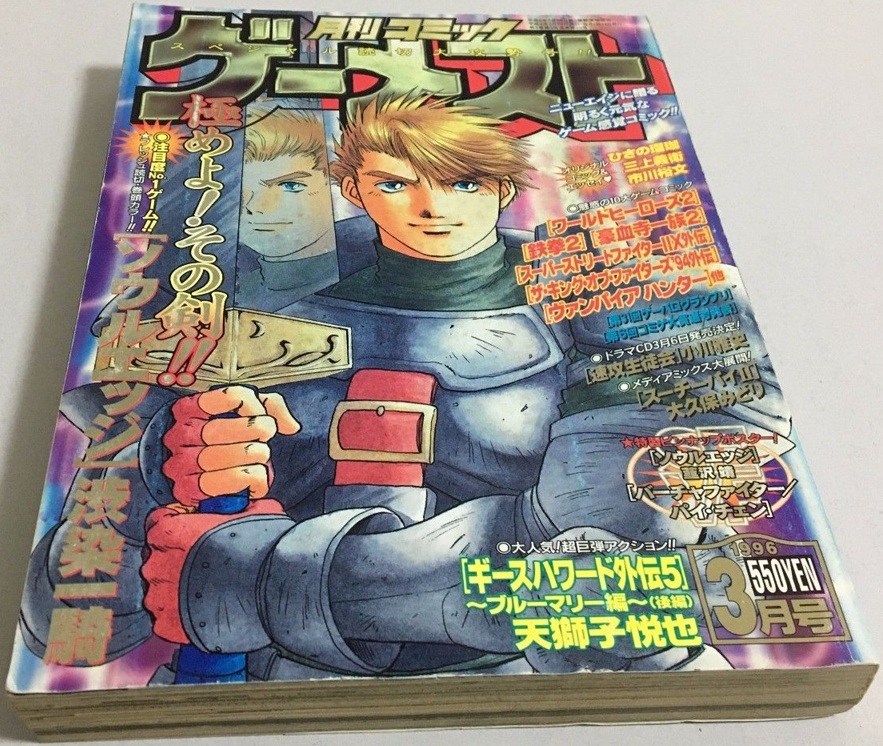
One of those pages shows bits of a tie-in one-shot manga, one of those Gamest one-off specials from March 1996 according to this Reddit thread.

Unfortunately, there's nothing else I can really find on that manga so all I can do is just show you and go, "Oh, hey, neat."


My final thought: I wish Mitsurugi had kept his 1P outfit for the sequels.

THE LEGEND WILL NEVER DIE