EDITOR'S NOTE:
I quit. This is selling out.
WRITER'S NOTE:
Don't be such a baby. If we were selling out, we'd do this on YouTube with red arrows, an AI-generated Peach and a title like "IT'S NOT WHAT YOU THINK??"
EDITOR'S NOTE:
... Alright. You're on notice but you've convinced me. For now.
Anyway, this review was primarily conducted on Mesen (using the palette recommended by The Cutting Room Floor) with a Switch NES controller for minimum authenticity (if we really wanted to be authnetic, we'd have imported a Switch Famicom controller, y'see) as well as on Switch with the same controller, plus a little bit on the other versions of the game with whatever controller was closest at hand. As this is a NES game and we are cursed with the knowledge of internal resolutions, the emulator spits out 256 x 240 when you take a screenshot but we decided on 292 x 240 (performed via dark HTML magic) which is a different value from Urban Champion but somehow it looks right for this game and not for that game. Maybe we should just jack it all in and make sure all our screenshots going forward are horrifying, non-Euclidean monstrosities with dimensions that can only be conveyed via interpretative dance or visible via a third eye. Alright, that's clearly enough from me.
Did you know the Super Mario Bros. 2 we got here in the West was actually a game called Tokimeko Memorial, directed by Hideo Kojima and only released for the Othello Supervision?
(To future historians, this is a joke. Obviously.)
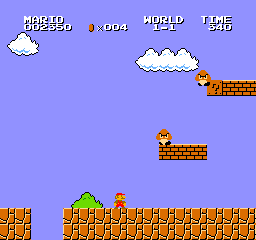
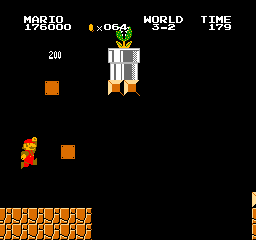
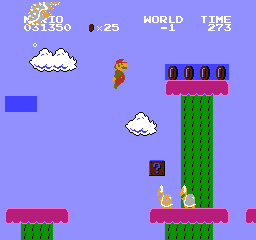
Alright, alright, we'll tell possibly the most famous switcheroo in all of gaming history properly, unironically. Look, we have to do this, we gotta set the stage for this one. Super Mario Bros. was released for the Famicom in Japan on September 13, 1985 and went on to become one of the most successful and influential video games ever made, but it didn't stop there for Nintendo. No, I'm not talking about the multimedia empire Mario would soon bring about or the many sequels and spin-offs, I'm talking about something a bit more basic- ports. I don't mean Super Mario Bros. Special either, listen, settle down, stop trying to get ahead of me, I'm the one writing here. What I mean is, the original Super Mario Bros. was reissued for the Famicom Disk System on the add-on's launch day, February 21, 1986 (according to this Japanese game software list) and an arcade version running on Nintendo's NES-based VS. System hardware, VS. Mario's Adventure VS. Skate Kid Bros. VS. Super Mario Bros., was also released early in 1986 but only outside of Japan as explained by Game Machine from March 1986 (via the Game Machine Archives). The FDS port of the game is mostly notable for having a set of four Minus World courses that, unlike the single one on the NES, can be completed (remember this for later) and it even dumps you back on the title screen when you're done, but the VS. System version, presumably in an effort to make it less easy for kids to last too long on a single coin, changed up a lot of things. Fortunately these are well-documented on the peerless Mario Wiki but for our purposes, the main thing is that 'clone' levels were moved around and replaced (as a quick example, 2-3, the Cheep Cheep bridge, was replaced by the harder version used for 7-3, while 7-3 itself was replaced with an even harder version of the course) and other stages were altered to remove some 1-Up Mushrooms and ? Blocks and generally make life harder for poor Mario & Luigi.
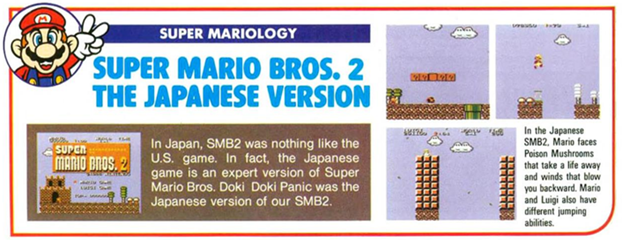
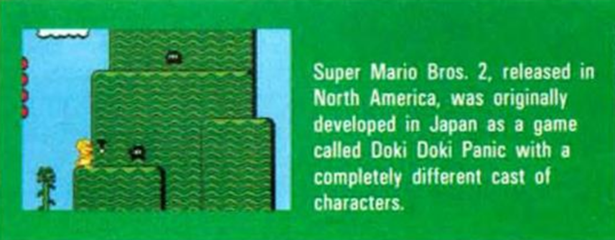
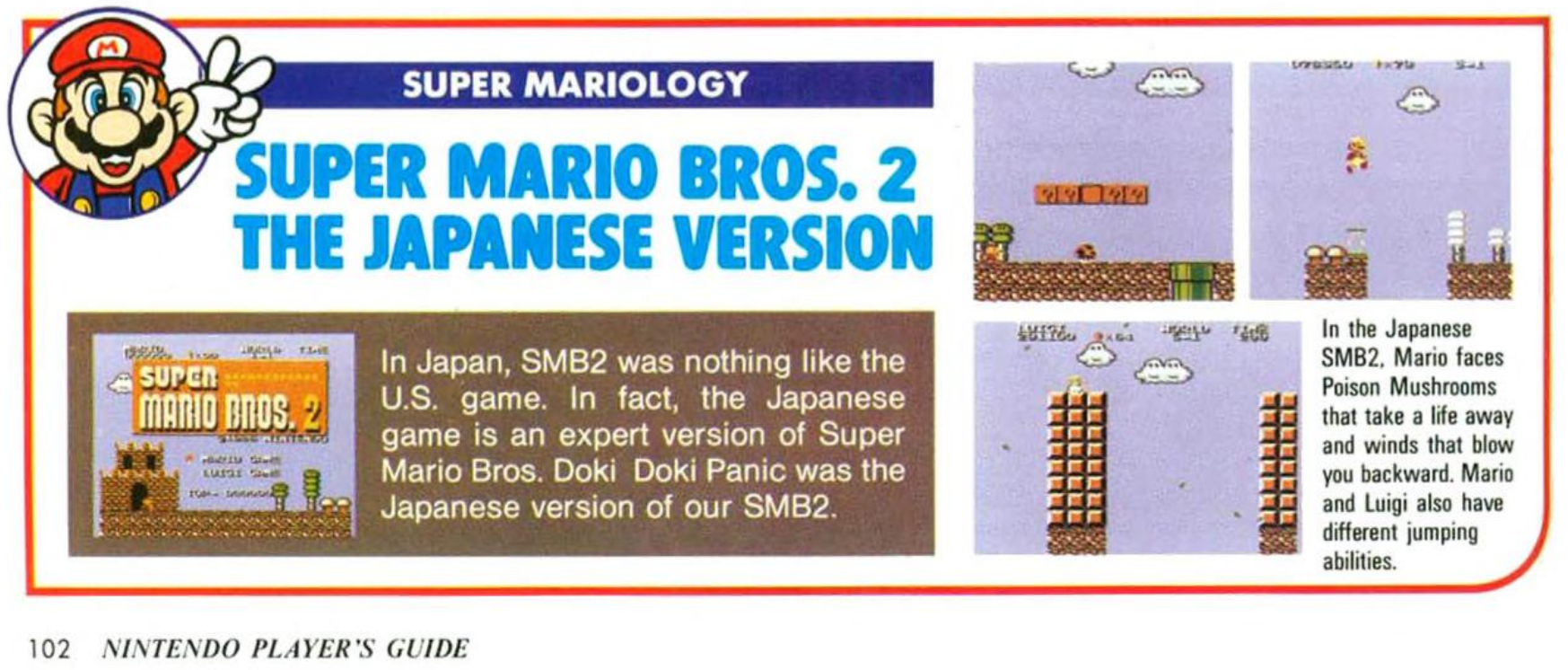
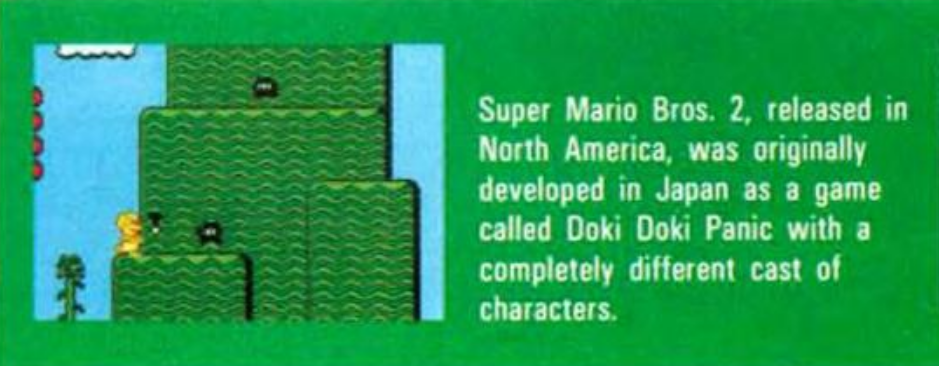
Why's any of this important? We're making our way there, I promise. In an interview for Mario's 25th birthday, Miyamoto himself explains that the staff had a lot of fun making the stages harder, and so they figured, why not make a game that's just another set of levels, more difficult than the original game? Thus, Super Mario Bros. 2 was born, although Miyamoto himself didn't have anything at all to do with it- he was busy making some little adventure game called The Legend of Zelda, if you see someone say Miyamoto made those levels, watch out- so Takeshi Tezuka, assistant director on the first game and Devil World hell yes, was in charge (it was his solo directorial debut, in fact, as explained in this interview). Super Mario Bros. 2, complete with a little seal on the cover reading "FOR SUPER PLAYERS", was released for the Famicom Disk System on June 3, 1986 and would go on to be one of the best-selling games for the add-on. The first game was already making huge waves across the pond at this point, so Nintendo would be gearing this one up for an international release to strike while the iron's hot, right? Well, no. Howard Phillips tells his story in the foreword for the Super Mario Bros. 2 book by Jon Irwin from Boss Fight Books (ISBN: 978-3-940535-05), and to summarise it, he got a box of games from Nintendo to evaluate for release in the US that included the sequel to the hottest game in the world, and in his own words, "What came next was completely unexpected...", going on to list various mean additions to the game, concluding, "This was not fun gameplay, it was punishment- undeserved punishment. I put down my controller, astonished that Mr. Miyamoto had chosen to design such a painful game.", adding that, "It was only later that I came to understand that Mr. Miyamoto had handed off most of the design responsibilities of Super Mario Bros. 2 to other Nintendo staff... [as he] focused most of his energies on the design of future hit The Legend of Zelda." Regardless of who was behind it, Phillips decided it was too similar to the first game, and too darn hard for the bowtie-wearing game master. He made his complaints known, and in a later product evaluation session, a new game was presented to him as Super Mario Bros. 2, which he recognised as a different FDS title, Yume Kōjō: Doki Doki Panic. A game created to tie in to the Fuji Television event of the same name, Nintendo decided to replace the original playable characters with the Super Mario crew to make a 'new' sequel that wasn't, to the Western consumer, just more of the first game. Thus, the great switcheroo happened and the new Super Mario Bros. 2 made Nintendo a lot of money for them, and they kept the original 2 under their hat for a little while (except for a tease in Nintendo Player's Guide: Mario Mania showing a few shots of the game). The people of the West would learn to love their own Super Mario Bros. 2 until Super Mario All-Stars told them the truth, presenting it as Super Mario Bros.: The Lost Levels, and that's generally how we know it today over here. We'll get to whether this was the right call later, but for now, why don't we take a look at this game deemed too tuff for the West?
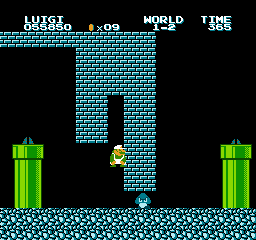
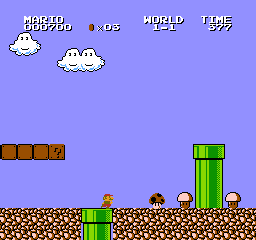
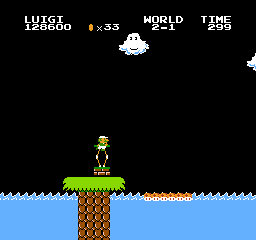
Super Mario Bros. 2 in Japan- which for clarity we'll be referring to as The Lost Levels so we're all on the same page- is Super Mario Bros. But More Of It, if you want to be a little reductive but mostly accurate. The closest contemporary analogue I can think of is Championship Lode Runner, ported to the Famicom in 1985, in that it's the same basic mechanics and (mostly) appearance but with different level designs. Lost Levels does a bit more than that though, as we'll see. The basics are the same- plucky plumbers Mario Mario and Luigi Mario must trek across the Mushroom Kingdom and through the many soldiers of the Koopa army, whose leader Bowser has kidnapped Princess Peach [Don't you mean Koopa and Princess Toadstool? Wait, hang on... - Ed] and turned the denizens of the kingdom into stones and bricks with his wicked magic. Only the Princess can undo the spell, and only the Mario Bros. can save her! Eight worlds with four areas each, always ending with a castle stage with a confrontation with a fake Bowser, await the brothers as well as Little Goombas, Koopa Troopas, Lakitus, secret areas, Warp Zones and more, who knows.
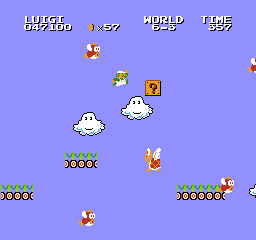
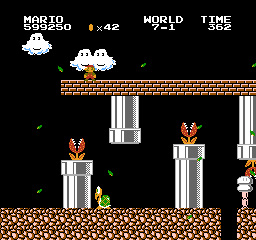
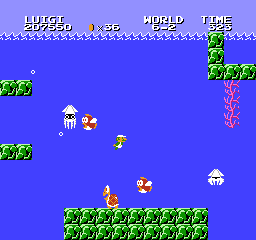
The general controls and physics are mostly the same ultra-smooth platforming from the first game- even glitches, like Lakitu's Spiny Eggs not having the correct behaviour and being able to wall jump with precise timing, aren't fixed- with the major change being how jumping on enemies is handled, as you get significantly more of a bounce by jumping on their heads. This makes chain-bopping enemies a little easier but the game expects you to learn the height boost you get from this rather quickly, so make a note of it, you'll need it. The other major change in this department is Mario and Luigi now being separate characters you pick at the start of your game- Mario plays the same as always, but Luigi can jump a lot higher both from a standstill and with a running start but, as a trade-off, his traction is terrible and he'll skid a lot more before coming to a stop. It's an interesting gimmick, and differentiating the brothers would become more common later in the series, but I feel that playing as Mario is the way to go here. Luigi is able to do some jumps a lot easier as he doesn't need to run (examples include the roof in 7-1 to skip the interior section with the pipes, the blind jumps in 4-3 and the Fire Bar block in 4-4) but Mario can do them with just a bit more effort, and the skidding is way more likely to get you killed than anything else. One of the great things about the original SMB is that the controls are so tight and precise, moving away from the slippery, slidey controls of previous Nintendo games like Mario Bros. and Ice Climber, so bringing them back and making them even worse just feels horrible. It's interesting if you want a challenge, but you'll be getting plenty of that anyway, so I definitely prefer to play as Mario. Sorry, Luigi, better luck next game.
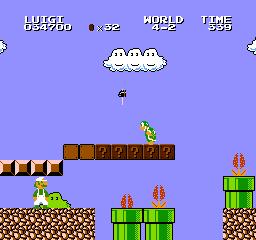
The Mushroom Kingdom itself's been given a new lick of paint, with a new tileset including more detailed rocks, different bushes and trees and smiling clouds (distinct from Lakitu's smiling cloud) but there's also a few new enemies and hazards lying in wait. Don't expect too many new sprites here though, they're mostly modified things you've seen before, but they're still worth looking at. For enemies, Bloopers can now fly above ground (and can be stomped on- the original game even has code to allow for this); Piranha Plants are replaced from 4-1 onwards by Red Piranha Plants that move faster, shoot up even if the player's standing next to the pipe (only stopping when the player is on top of the pipe) and even appear in upside-down pipes; and Hammer Bros. from 7-1 onwards can appear already in the rarely-seen 'pursuit' mode, moving towards you instead of just guarding a specific area, maybe the most terrifying thing imaginable. New hazards include green springs that catapult your helpless plumber so high that they stay off the screen for several seconds, strong gusts of wind that blow behind the brothers to let them jump further but also constantly moves them even when standing still and of course, the infamous Poison Mushroom that acts like an enemy, hurting or killing the bros. rather than boosting their power. Not exactly a huge amount of new features for a sequel, but they're interesting twists on obstacles players familiar with the first game would've seen before, adding a bit of extra variety. One example I like is 7-1, where the wind is blowing as you navigate an enclosed area of Piranha Plants and Koopa Troopas, threatening to send you into the enemies as you try and progress, I almost wish there were more examples of the wind being used like this! Oh, and the green springs are pure comedy, a joke described by Bluesky pal iiotenki as "shitpost incarnate", all it's missing is a Looney Tunes-style whistle to go with your plumber plummeting back to terra firma.
Calling an obstacle 'pure comedy' segues nicely into the real appeal here, the all-new level designs, which leads me to an important point:
Super Mario Bros.: The Lost Levels is basically a slapstick comedy in video game form.
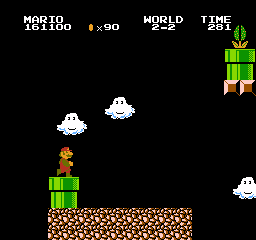
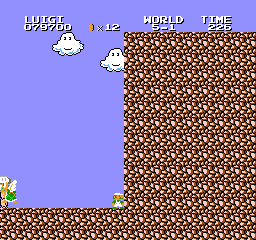
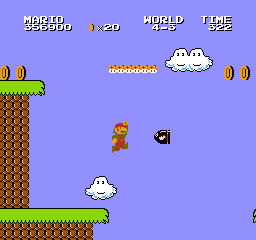
Yes, this is the meat of the game, 32 new courses (well, mostly, as some get reused from VS. Super Mario Bros.) to conquer. At least part of the reason I feel the way I do about these new courses is a bit of wisdom from Ultra Powerful Pal of Gaming Hell, sharc (hi!), who said in my first stream of the game, "in single player games, having a good sense of humour about failure is more important than any amount of raw skill". Not only is this true from a stream performance point of view, it's even more true when playing the game on your own, just you and the Mushroom Kingdom locked in battle. A lot of people talk about The Lost Levels like the course design hates them, and I mean it kinda does, but that's not a fun way to engage with the game, so let's take a different angle. As mentioned earlier, the level designers had fun putting together difficult courses, and this is something I absolutely believe, because as well as being challenging, there's a lot of funny jokes played on the player throughout them that sometimes kill them, other times merely inconvenience them in a funny way and I think that's really important to approaching the game and having fun with it. We have to get a little into the game before that starts though, so let's take a whistle-stop tour of the Mushroom Kingdom, highlighting some interesting and insidious parts in a haphazard order as we go along.
It starts fairly gentle, all things considered, feeling less like a direct continuation from 8-4 of the original game and more like something from the mid to late game, but for those who played a lot of the first game, it's exactly what they'd expect- more SMB courses to traverse with increasing complexity and challenge. 2-2 is your first taste of blood, with hidden blocks- previously a way to find hidden 1-Ups- being required to reach a pipe to make it across a large pit, something the game returns to comically in 5-1 where the course seemingly ends at a screen-sized wall you have to scale via hidden blocks. Is this unfair? Well, not entirely- the first example is near an extremely obvious pit that there's no way you can jump across, so you do have to use your head a little (a bit literally) but if you're familiar with the original, you'll know that invisible blocks definitely exist, so you can figure it out, and the sheer wall leaves you with no option but to jump around and find out. Howard Phillips also complained about leaps of faith, and they start fairly early too, the first one being in 4-3 that has three of them, with one of them requiring you to hit a Koopa Paratroopa on your way across and another with Bullet Bills randomly firing across the screen (wait until one passes by before going for it). They absolutely ramp up later, especially in World 8 where you need to time it to bounce off a Koopa Paratroopa mid-flight (sometimes more than one!) but they're not as prevalent as Howard makes it sound. Even so, there is something a bit funny, a little The Three Stooges about not quite having enough juice to a jump and falling short, and while there is a memorisation element to some things, I think if you have a decent amount of general arcade-action experience, you'll pick things up pretty quickly and can react to these leaps of faith, especially since some of them are timed for you to just keep moving to clear easily. Well, at least I can, a gamer of impressively mediocre skill. You lot can probably do even better than that, I've got faith in you.
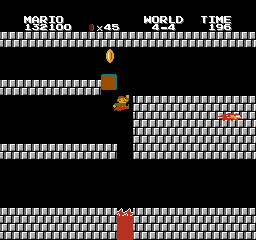
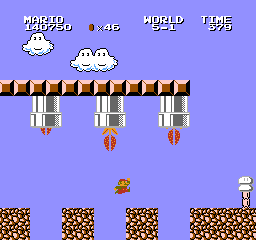
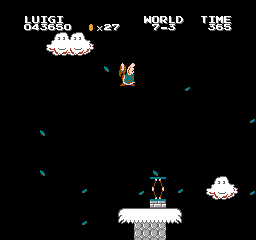
Still, those aren't exactly jokes, are they? They're more unexpected challenges for the player to face. No, no, the real jokes are the little things, goofs that exploit some of the oddities of the original game or things people would be familiar with. Items are a fun one, for example, as you might not know that if you spawn a power-up (Super Mushroom, Starman, etc.) when another one is already on-screen, the first one disappears. In the original game, this is something you'll rarely see, but The Lost Levels actively makes sure it happens, like in 1-2 where there's a roof you can hit that has a 1-Up Mushroom next to a Super Mushroom / Fire Flower, next to another 1-Up which is next to another power-up just to mess with you, or 6-1 where you can easily despawn a 1-Up with a Starman and vice-versa. Seeing an item you want snatched away from you is pretty funny! Speaking of items, the Poison Mushrooms in particular are used in increasingly derranged and funny ways across the game, like 8-1 having a long row of ? Blocks where one of them has a Super Mushroom that you have to wait until the end of the row to get to, but there's also a Poison Mushroom waiting in one of the last ? Blocks, which will despawn the Super Mushroom, as a punishment for your greed. Many hidden blocks also contain Poison Mushrooms just to rub it in, and even blocks in difficult-to-reach places will have a Poison Mushroom as a gag, just to mess with you. Eventually you start getting a sixth sense for where the Poison Mushrooms are (or trust issues with the designers of video games, one or the other) because it's usually the funniest place that the designers could put them. The aforementioned green springs are just comical in and of themselves and are the core of one of the toughest courses, 7-3 which is a series of suspended platforms over bottomless pits where you have to rely entirely on green springs to catapult you off-screen, testing your mastery of figuring out how long you're in the air and where you'll land to safely make it across. Be too ambitious and you'll fall to your death, be too cowardly and you'll have more tricky platforming to deal with. Does that sound mean? Yeah, it's pretty tough, but it's an interesting challenge not seen in the original game, one that even gets iterated upon later as we'll see.
Some more good gags? Sure, I can keep going. The way off-screen obstacles are handled can lead to comedy too- 8-1 has a Buzzy Beetle in front of a Hammer Bro, and you can kick its shell to easily deal with that guy... But the blocks both behind you and ahead are just placed within the boundary of being active so that shell will definitely come whizzing back towards you, better be ready to jump. Even Super Mushrooms can be used as a mean joke- 3-4 has a hidden power-up in the first looping section, but you can only progress by taking the lowest path, so if you grab it, you have to take a hit to progress (well, unless you can slide under all of them as shown here, apparently not a tool-assisted speedrun exclusive trick). This does lead to a slight trend in the game that low-key punishes you for being Super Mario- many tricky and tight jumps are actually made harder if you're big like the series of bricks guarded by a Hammer Bro in 8-1, and it frequently happens in the castles where you have to squeeze your plumber's stacked form into those thin corridors. The hidden Super Mushroom in the single-screen pipe jump room in 8-4 is particularly cruel because you have to tackle that jump totally differently depending on your size! It's certainly an interesting wrinkle on an element only rarely toyed with in the first game. One more item-related goof that I love is the use of Starmen- early on you get them quite frequently so you learn to trust them, but later on like in 7-1 and 8-2, Starmen will prevent you from jumping on top of enemies because you'll pass through them, which denies you an alternate route in 7-1 but completely prevents progress in 8-2! 8-2 is also an example of the looping labyrinth areas appearing outside of castles now, which is probably the weakest 'mean' design streak as it's just a case of memorising where to go, and outside of castles there's usually a more obvious solution (they remain very mean in castles and I think you could've removed them and the game would've been better for it, but there's something a little comical when you realise the correct route in a castle is almost always 'the path of most resistance').
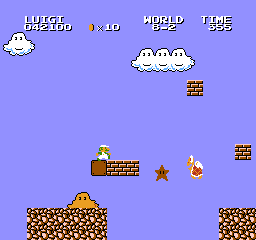
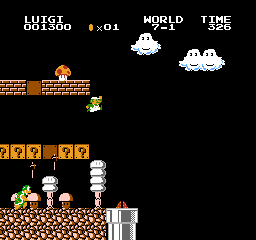
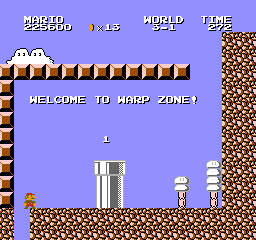
Even finer jokes are played on those who paid attention to the secrets of the first game and even rumours spread about it. 1-2, for instance, has a surprise in store, as taking the traditional route to the Warp Zone only takes you to World 2. There's actually a miniature maze hidden in the course with pipes that can send you backwards through 1-2 but also lead to Warp Zones for Worlds 3 and 4 if you're clever with finding hidden blocks. Surely there must be even better hidden Warp Zones later on then? Well, a certain green spring at the end of 3-1 lets you fly over the flagpole at the end of the course. While possible in 3-3 of the first game via a glitch, this time you can do it properly and it even leads to a Warp Zone!... That takes you backwards to World 1. Perfect. There's even a pit for you to walk into if you've been fooled, a courtesy not done for the backwards warp in 8-1 that takes you to World 5. World 9 (which we'll get to later) even has an homage to the glitchy worlds of the FDS port of the first game (told you we'd come back to it) with a swimming course transplanted onto an overworld course complete with enemies that have no business being underwater and coins that leave background artifacts when collected. Things like these and the other goofs that exploit the peculiarities of the first game really hammer the point home that these were courses designed by people who just had a blast putting together tough challenges because of their love of Super Mario Bros., and while some of them are mean and designed to kill you, you get the feeling they were made with a wink and a nod. They know it's a bit silly with it, they're in on the joke, and that's something that turns the game from being just difficult to having a strange charm, a slapstick comedy where both you and the designers are laughing when Mario bites the dust. One thing that doesn't happen as often as you'd expect is the concept of the 'kaizo block' dervied from their usage in Kaizo Mario World, where hidden blocks are used to punish the player by trapping them somewhere or blocking their jump arc to send them into a pit. There are examples here and there for sure- 4-4 has a few to prevent you from switching lanes near the end, 8-2 and 8-3 do the same trick 8-3 did in the original game by hiding actual bricks in the brick backgrounds (usually Poison Mushrooms, of course)- but they're not as prevalent as you'd expect, and at least one of them (the hidden 1-Up in 7-1) got me so good I had to stop playing for a second because I was too busy laughing. They're used infrequently enough that they don't define the game by any stretch, and the challenge (and goofs) are definitely plentiful in other ways.
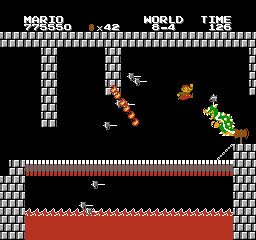
There is one final element we have to consider, though, and that's lives. See, that Miyamoto interview for the 25th anniversary mentions that they intentionally put a few places in 1-1 to do the old 'infinite' lives trick with a Koopa Troopa- yes, they didn't fix that glitch either, and it'll still roll over and count as a Game Over if you're too greedy- in order to prepare yourself for the rest of the game. If you decide to skip that though, you start the game with three lives and continuing sends you back to the start of the world you're in. I'm a stubborn idiot (this website is nearly 20 years old so of course I'm stubborn) and so the first time I properly played it for my stream, I elected not to use the lives trick. Played this way, the game's difficulty is tough but reasonable for the first four worlds (except for 3-4 which, of course, is a labyrinth castle where you have to take the correct path, good luck figuring it out before running out of lives!), takes the kid gloves off for Worlds 5 and 6, and then becomes much tougher for Worlds 7 and 8, with much for you to learn and practice before you can get a clean run of them. Sadly, 8-4 did indeed humble me (as pointed out in my chat, The Quest of Ki didn't defeat me but this game did) and I had to resort to limited savestate use during my first stream because, well, 8-3 is a hellzone of low-flying Lakitus, Hammer Bros. with no rows of bricks to aid you and multiple leaps of faith, and doing all that on top of trying to learn the labyrinth of 8-4 which includes a pipe you can get stuck on that sends you all the way back, plus a devilish Koopa Paratroopa blockade and also two Bowsers (this, too, is a funny joke). That's when it gets just a smidge too much for only three lives, at least for an average gamesperson such as myself, and especially on my first try. I've gone on to successfully beat the game this way in my own time, and I tried a few times with the lives trick, coming to the conclusion that while I kinda prefer doing it with the default set if lives (it makes you learn each course in and out, finding extra lives and secrets in the process, as frustrating as that process can be at times), the lives trick is an equally-valid way to go about it, I mean, they intentionally put it there! Although in yet another gag, if you have too many lives left over after completing 8-4, you won't see the full end sequence because it'll take too long calculating your score bonus from all those spare lives!
The game is not over after World 8-4, though. More challenges await those who crave them.
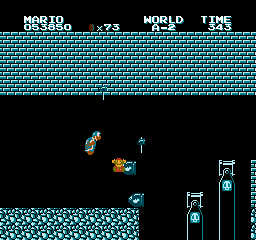
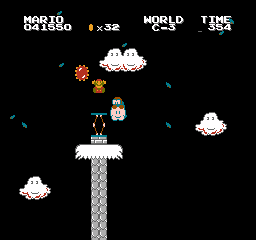
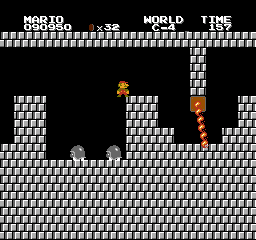
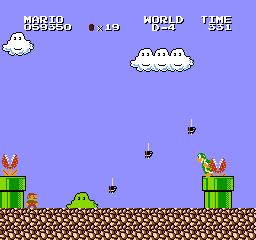
There's four more Worlds to tackle- Worlds A, B, C and D- but getting there on the original FDS version is a bit of a grind, probably on purpose. Completing the game eight times- your number of game clears is displayed by stars on the Super Mario Bros. logo, you can use Warp Zones to speed this up and the number of game clears is saved to the disk- then holding A and pressing Start on the title screen sets you on your new journey. Sure, beating the game eight times seems a little excessive, but I think this is the game's way of saying that you must really, really want more of a challenge to get to these worlds, and you certainly get it, as these continue to escalate the difficulty with more blind jumps requiring much more precision, more wind, just more of everything you've seen so far. That said, I think World C is perhaps the funniest world in the entire game because two of the courses are just very slightly modified versions of courses seen previously with a singular change that makes them so much harder. C-3 is 7-3- the trampoline hellscape we talked about earlier- but with a series of Lakitus perfectly placed to throw Spiny Eggs at the worst possible time (in particular, if you leave the first one alive, it'll often throw a Spiny Egg at a falling platform at just the right time for you to collide with it as you land from a spring jump) and C-4 is 7-4 with blocks added in the safe spots of the little pits with the Fire Bars, so you can't sit in the corner and bide your time, you have to do it in one swift motion with precise timing. These two examples really show that the level designers were so intimately familiar with the mechanics and physics of the game that they knew the tiniest changes you'd need to implement to make already-tough courses even tougher which is extremely funny and says a lot about the thought process behind the game.
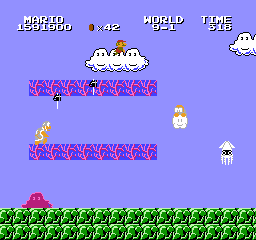
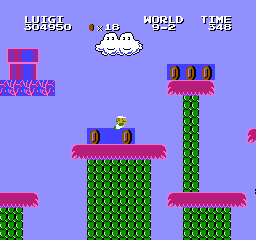
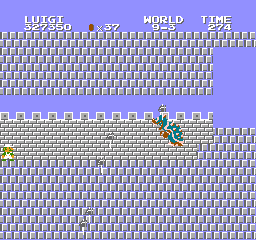
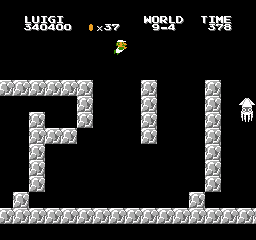
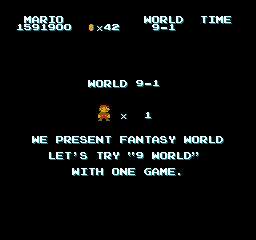
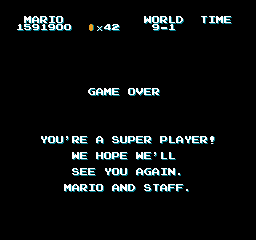
There's also World 9, which you can visit before the alphabet worlds but I wanted to save it for last as I feel it says a lot about the design process behind the game. Completing Worlds 1 to 8 without using any Warp Zones (yes, that includes the joke ones that send you backwards) brings up the screen above, challenging the player to tackle this 'Fantasy World' with just one life. Fortuntaely, it's not as scary as it sounds and this is more like a victory lap, with courses specifically made to be a little strange- two swimming courses that take place overground (and specifically call back to the FDS Minus World with their glitchy appearance), one bizarre outside castle course and a final swimming course at night with blocks spelling out アリガトウ! (arigatō! / thank you). Even if you don't quite manage to beat World 9 (although even if you do, it loops until you die), you're still congratulated with a special message from Mario and the game staff, so it's essentially a victory lap, a way of telling the player they've done a good job making it through this tough-as-nails game.
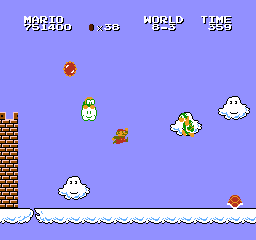
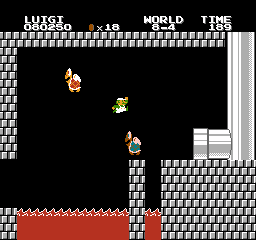
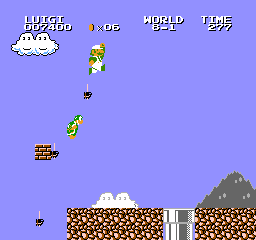
As we wrap things up here, let's loop back around to the big ol' switcheroo that happened because ultimately, I think Nintendo of America made the right call. In Japan in 1986, Super Mario Bros. 2 on the Famicom Disk System made complete sense as a ¥2600 disk game that you can rewrite if you want (or get it even cheaper at a Disk Writer station for only ¥500) that's an expansion pack for a ¥4900 cartridge game (prices taken from this fansite). In America in 1987 (which is probably when it'd end up releasing because they'd have to convert it from disk to cart- shoddy pirate cart versions don't change the palette for the Red Piranha Plants, just an idea of what can go wrong), Super Mario Bros. 2 on the NES doesn't make sense as a full-price cartridge that's an expansion pack for a full-price cartridge game. That's a bit of a harder sell, although I'm explaining this purely from a marketing perspective (side-effects include nausea and self-loathing). Interestingly, in Jon Irwin's Super Mario Bros. 2 book, Gail Tilden has a few words to say and explains that she made a pitch of releasing The Lost Levels in the US on the NES as a subscriber bonus for Nintendo Power like they had with Dragon Warrior, but NoA shut it down as they didn't want to "confuse the market". That's a real shame, as I think that would've been the perfect way for it to make sense as a US release, a nice exclusive extra rather than a full standalone release. Even so, it worked out quite nicely in the end- Doki Doki Panic itself never got rereleased but a fun platformer got to stay in print thanks to its Mario reskin, the reputation of Mario in the West was preserved even if no-one could get a copy of SMB2 thanks to the chip shortages, and Nintendo got an extra selling point for Super Mario All-Stars on the SNES in the West many years later with the new-to-the-West 'Lost Levels'. Everyone's a winner! Well, Nintendo wins, mostly.
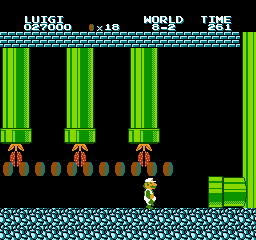
This is probably a pretty strange sounding article, now that I'm this far into it, as a lot of it's been me rattling of examples of the game having a bit of a mischievous streak, but that's OK, right? The thing is, I kinda like this game, it reminds me a lot of The Quest of Ki in that it's tough and prone to playing jokes on you but it's an enjoyable challenge, and so I wanted to explore what those jokes were a little. Is it difficult? Absolutely, especially if you elect not to use the lives exploit, where you'll need to practice and learn every mean trick the game throws at you. However, the solid and fun movement mechanics of the original SMB are present and correct and so the game feels good to play, offering a new set of challenges that play with your expectations a little, striking me as courses that were made by people intimately familiar with the first game and exploiting little quirks and oddities to their advantage. Besides, even if you fall victim to a trick, there's often a way to recover and keep going, which can't be said for some games. The labyrinth courses are a weakness for sure since they're just a little annoying (plus sometimes the game is fussy as to whether it counts as the right path or not, especially in the castles) and some players are definitely not going to have the patience for this, and that's OK. I just had a whale of a time going against the challenge, even as I was cussing and laughing!
I suppose if you're well-versed in difficult platformers, you might be expecting me to extrapolate something about The Lost Levels and the trend of platformers in the 00s of playing jokes based on the expectations of players such as The Big Adventure of Owata's Life, Syoban Action and I Wanna Be the Guy, or maybe something about the trend of 'Kaizo' hacks of Mario games that exploit intricacies about the games such as Kaizo Mario World or go even further back and give a shoutout to Tonkachi Editor, an unlicensed 1987 Famicom Disk System hex editor that had its own Super Mario Bros. hack to demonstrate its capabilities, that sort of thing. Well... Nah. First off, you're expecting too much of me, I ain't that smart. Secondly, this is definitely distinct from those kinds of games, mostly in that the courses aren't obviously absurd and usually- usually- give you an opportunity to react to things happening such as a leap of faith or the appearance of a Hammer Bro (although even now, eight clears in, they still strike fear into the depths of my heart) whereas those other examples are either much more memorisation-heavy or require in-depth knowledge of how the game's mechanics work to even get started (The Lost Levels never expects you to do any wall jumps, for instance). You might also be expecting me, if you're a bit silly, to muse on whether the approach Lost Levels takes is Goode Game Designe- as if that sort of thing's set in stone and immutable- to which I say, "Well, shit, it made me laugh". Again, approach this with a sense of good humour, ready to be digged at a little by a nearly-half-century-old-game, and I think The Lost Levels is a fascinating, frustrating but fun platformer. Or, you know, play the other Super Mario Bros. 2 instead, I won't mind.
For being made for super players, Super Mario Bros.: The Lost Levels is awarded...

In a sentence, Super Mario Bros.: The Lost Levels is...
A practical joke that super players are in on.
And now, it's that time, folks!
EXTENDED PLAY!
The only other business this time is looking at rereleases, including the game's debut overseas.
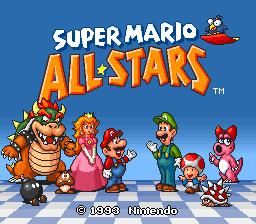

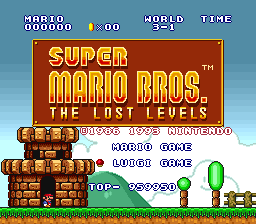
We begin, of course, with 1993's Super Mario All-Stars (Super Mario Collection in Japan) for the SNES.
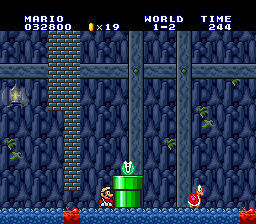
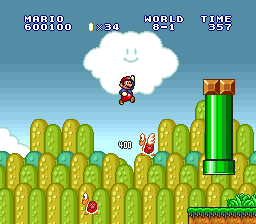
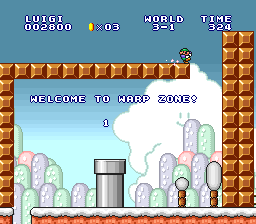
A collection of the four main NES / Famicom Super Mario Bros. games, that means they have to tackle the regional disparities head-on. Over in Japan, it's a bit simpler as the Western Super Mario Bros. 2 had been released over there on Famicom cartridge just the previous year as Super Mario USA, so they get to keep their original 2 mostly as-is, although they actually change the title screen to read Super Mario Bros. for Super Players, a title we'll see again later. Outside of Japan, it's a bit more complicated, but this is where we get the big rebrand, as in the West, Super Mario Bros. 2 for the Famicom Disk System was officially rechristened Super Mario Bros.: The Lost Levels in this game and the name stuck. The box and manual are a bit vague about its origins- the back of the box says "the previously unreleased 'Lost Levels are included. These super-challenging courses have never been available in this country until now!" and the manual just calls it "a special version of the original Super Mario Bros." adding that "the game is much more difficult". The later rerelease that includes Super Mario World is a bit more explicit about it, with a little stamp reading "Unreleased in the USA / Europe" which is the one shown above.
It's mostly the same as the original with a fresh lick of paint, but there are some little differences here and there, mostly documented in punishing detail on the Mario Wiki, so we'll just go over the basics. First and foremost, there's progress saving now, and unlike the other games in the collection, The Lost Levels saves your progress on every course rather than every world, and this applies to continues too, so if you lose all your lives on 8-3 (each continue has five lives by the way, not three!), you can continue from there rather than having to restart at 8-1. World 9 also lets you keep any extra lives you have once you enter it (and misses out on all the glitchy graphics, aww) and Worlds A-D start straight after 8-4 (or 9-4 if you got there without warping) without having to beat the game eight times. Other changes include making Worlds A-D harder (Goombas are replaced with Buzzy Beetles, Hammer Bros. always start in 'pursuit' mode, Bowser uses hammers instead of fire, Worlds A-C no longer have checkpoints), destroying bricks has slightly different physics and the game sharing its graphics with the Super Mario Bros. remake in the same collection rather than using a different tileset. I'm a little mixed on this, really- being able to continue from the last course reached is very convenient, but it does make the game a little less savage and some of those little changes (especially to World 9) take away a bit of the charm. If you're not a sicko, then perhaps this is the version for you, especially if you want to take a break rather than have to beat the whole game in one session.

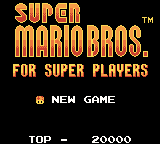
Next up is 2000's Super Mario Bros. Deluxe for the Game Boy Color (only released as a Nintendo Power cart in Japan).
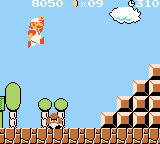
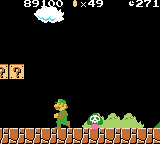
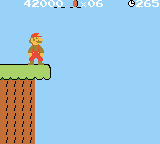
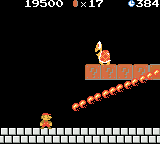
An enhanced port of the first game with all the features you hip 2000s cats want like a Challenge Mode to reach score targets, find five hidden Red Coins and find the Yoshi Egg in every course, infra-red high-score swapping, Game Boy Printer support and a serious case of screen crunch, this has a most curious secret mode- For Super Players, the most scuffed way to play The Lost Levels. Unlocked by beating the default high-score of 300,000 in Original 1985 Mode, selecting the newly-appeared Luigi head on the main menu takes you to this version of the game, with only one save file unlike Original 1985 Mode's generous three, but once you unlock a level you can select it from this menu. Completing this mode also gets you a nice Yoshi Award for your in-game Album, so that's nice.
As for how it plays, oof. the first game's graphics are used (including replacing the cloud platforms in 8-2 and 8-3 with Lakitu's cloud) as well as the original game's physics- you can switch to Luigi on the map screen but it makes no difference, jumping on enemies no longer gives you a bigger boost off them and even the wind mechanic is not implemented. Several courses had their designs altered to account for this, so you're less reliant on bouncing on Koopa Paratroopas to make it across certain gaps. All the secret Worlds (9, A-D) are gone too but, as pointed out on The Cutting Room Floor, incomplete versions of them are in the game data, missing things like enemy spawns, flagpoles and obstacles so most of them can't be completed. It's certainly playable, but it's missing quite a lot (but it is funny that they removed the wind but kept the Super Spring on a console with such limited screen real estate) and is a pretty sub-optimal way to play the game. If you want bragging rights though, take this version on!
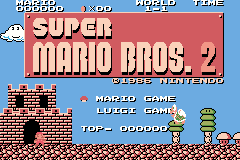
Skipping ahead a bit, our next rerelease is 2004's Famicom Mini: Super Mario Bros. 2 for the Game Boy Advance, released only in Japan.
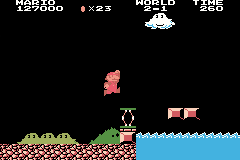
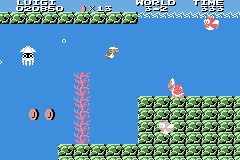

Famicom Mini was the Japanese version of the Classic NES Series of GBA rereleases of NES games but had a much longer life- there were thirty games released like this (and two extra games given away as prizes!) and Super Mario Bros. 2 was the twenty-first of them, complete with an adorable box-within-a-box that houses a miniaturised Famicom Disk System box (please note the important 'ORIGIN OF OUR TV GAMES' seal) that has the GBA cartridge in it. While mostly a direct emulation of the FDS game, the Mario Wiki and The Cutting Room Floor cover the small differences- the graphics have been scrunched a bit to cram the game onto a GBA screen (including shrinking the text a little), you can hold A or B as you boot the game up to display a recreation of the FDS boot-up screen, you can hold A and press Start to continue from the last world you reached up to World 8 (this can be saved to the cart too by opening the emulator menu with L & R) which means you can get back to the title screen and switch between Mario and Luigi then continue from the last world you were in, and the input to start World A is holding B and pressing Start. The scrunchy graphics are very strange, but the little additions and being able to select a world is a nice compromise between the unfeeling meanness of the original and the course saving from the SNES version.
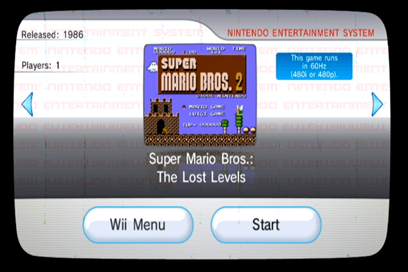
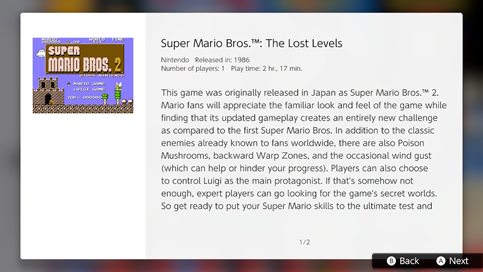
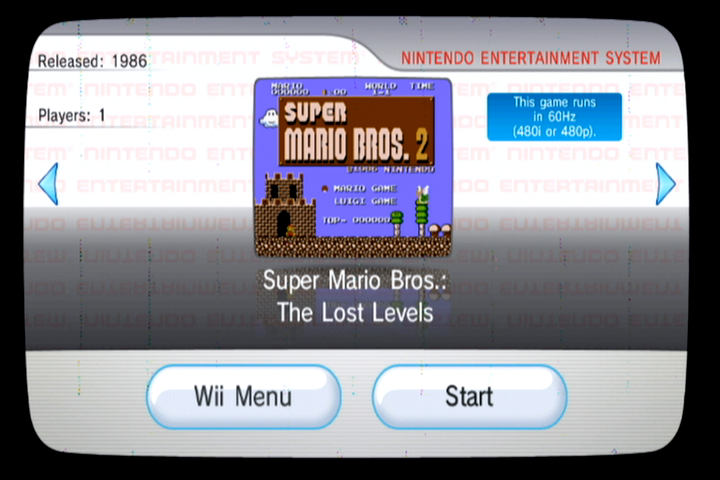
From this point on, we've only got Virtual Console, eShop and Nintendo Switch Online rereleases to deal with, so we'll be quick. Still, the first such rerelease, in 2007, was a big deal- the first time the original Famicom Disk System version was released outside of Japan on the Wii Virtual Console. The release in Europe was particularly strange- the 2007 release was part of Nintendo's Hanabi Festvial promotional event where they'd release games on VC that weren't previously released in Europe, including games like Bio Miracle Bokutte Upa, Gley Lancer and Ogre Battle 64. The Lost Levels was part of the first Hanabi Festival as a limited-time download, then later was made available in the third Hanabi Festvial in 2008, sticking around until the service's shutdown in 2019. Weird, 'cause everywhere else got it rereleased normally in 2007! The 3DS Virtual Console got the game in 2012, the Wii U Virtual Console got it in 2013 (in Japan) / 2014 (everywhere else) and the Switch Online (later Nintendo Classics) service got it in 2019. Annoyingly, while the Switch service has those 'SP' versions of games with savestates to skip ahead or unlock certain features, they didn't think to do this for The Lost Levels to have access to World A, B, C and D immediately. That would've been a good use for that!

... Oh, wait, there's one more that we can't really show- 2020's Game & Watch: Super Mario Bros., a standalone handheld unit.
This was a limited-edition release and I never got the chance to get one- yes, it was part of the same 'limited run' bullshit as Super Mario Bros. 35 and Super Mario 3D All-Stars- so the screenshot above and the following information come from The Cutting Room Floor. This version is a straight emulation but adds some very welcome features- an infinite lives mode (hold A on the title screen before starting your game and being able to start a new game from any World you've previously reached using a modified version of a similar feature in the original Super Mario Bros., with World 9 still being locked off if you use this to skip ahead, but Worlds A, B, C and D being selectable once you meet the eight clear requirements. Sounds like a pretty nice way to play the game, assuming you're alright to play it on a screen the size of a typical Game & Watch game. Better put your glasses on for that one.
Alright, this is it, this has to be the most well-known game we'll ever cover. Right?
Don't count out Gaming Hell from covering popular games anytime soon! We'll write about anything! Well, mostly.